
 Beck’s Toolbox
 Knives
 DIY Build Kits
 Digital Downloads
 Machine Accessories
 Fabricating Materials
CNC Plasma Cutting
Why Torch Lead Routing Matters on a CNC Plasma Table
Aug
Why Torch Lead Routing Matters on a CNC Plasma Table
The torch lead is easy to overlook when setting up a CNC plasma table.
It is flexible, so it may seem like you can simply route it wherever it fits and start cutting.
But that heavy cable is constantly pulling on the torch as the gantry moves around the table.
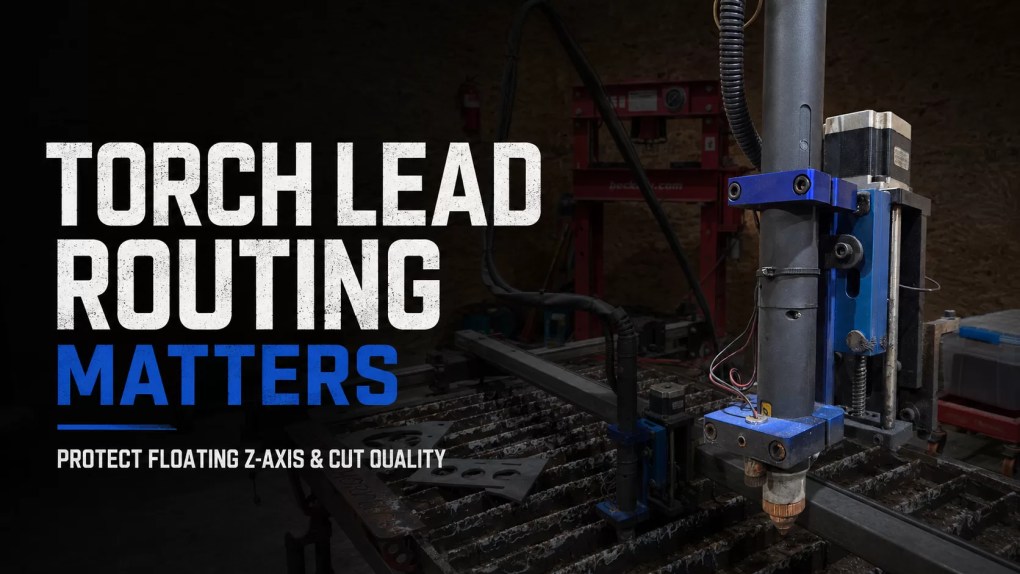
On machines like the Langmuir Systems CrossFire, improper torch lead routing can do more than pull the torch slightly out of position. It can actually interfere with the operation of the floating Z-axis, initial height sensing, and torch height control.
A good torch holder keeps the torch secure.
Good lead routing keeps the cable from fighting the Z-axis.
How the Floating Z-Axis Works
The CrossFire Z-axis has approximately 0.200 inch of float.
The floating portion of the Z-axis is normally held down by gravity along with the weight of the plasma torch.
At the beginning of a cut, the machine lowers the torch toward the material.
The sequence works roughly like this:
- The Z-axis moves downward.
- The torch contacts the workpiece.
- The main Z-axis continues moving downward.
- Because the torch cannot move farther down, the floating Z assembly moves upward on its rails.
- That movement activates the limit switch.
- The machine now knows where the material surface is.
- The Z-axis retracts the floating distance plus the programmed pierce-height offset.
- The torch fires at the correct pierce height.
That small amount of floating movement is an important part of establishing the correct starting height.
If something other than the material moves the floating Z-axis, the machine can receive incorrect information about where the material actually is.
The Torch Lead Can Lift the Floating Z-Axis
This is where torch lead routing becomes extremely important.
Imagine the torch is near one side of the table and everything works perfectly.
Now the gantry travels to the opposite side.
If the torch lead does not have enough slack, it begins pulling upward on the torch.
Because the floating Z-axis is held down primarily by gravity and the weight of the torch, the cable does not need to create a huge amount of force to start lifting it.
If the lead becomes tight enough, it can physically raise the floating Z-axis.
At the extreme, it can lift the assembly far enough to activate the limit switch.
Now the machine sees the same signal it would normally receive when the torch contacts the material—even though the torch is nowhere near the material.
That can completely disrupt the normal height-sensing sequence.
It Does Not Have to Hit the Switch to Cause Problems
The torch lead does not have to lift the Z-axis the full 0.200 inch to create problems.
Even a smaller amount of upward force can partially lift the floating assembly.
The torch may still appear to be in approximately the correct position, but it is no longer resting naturally at the bottom of its floating travel.
That means your actual torch height can differ from what the machine expects.
Even a relatively small height error can affect:
- Cut bevel
- Kerf width
- Arc stability
- Hole quality
- Dross
- Consumable life
- Overall cut consistency
This can be particularly frustrating because nothing may look obviously wrong with the machine.
The problem is simply the torch lead pulling upward on the floating Z-axis.
Torch Height Control Can Make the Problem Worse
Once cutting begins, torch height control, or THC, monitors the plasma arc voltage and adjusts the Z-axis to maintain the desired cutting height.
If the torch lead is physically pulling the floating Z-axis upward, the torch can be held farther from the material than it should be.
The THC sees that incorrect condition and begins trying to compensate.
The machine may command the Z-axis downward while the torch lead continues pulling upward.
Then the gantry moves to another area of the table and the cable tension suddenly disappears.
The floating Z-axis drops back down under gravity and the weight of the torch.
But the THC has already been commanding additional downward movement to compensate for the cable tension.
The result can be a sudden drop in torch height.
In a bad enough situation, the torch can actually drop into or contact the workpiece.
What initially looked like a THC problem may actually be a torch-lead-routing problem.
Why the Problem Changes Across the Table
This issue can be especially difficult to diagnose because it may only happen in certain areas of the table.
Near the side where the plasma cutter is located, the torch lead may have plenty of slack.
The machine cuts perfectly.
Move to the far side of the table and the lead becomes tighter.
Now you may suddenly see:
- Different cut height
- Increased bevel
- Torch-height fluctuations
- Unexpected Z-axis movement
- Poor cut quality
- False floating-Z switch activation
- The torch diving toward the material
The plasma cutter, consumables, program, and cut settings have not changed.
The only thing that changed is the position of the gantry and the amount of tension in the torch lead.
Leave Enough Slack at the Torch
The torch lead needs enough freedom to allow the Z-axis to move naturally.
The cable should never be supporting part of the torch’s weight or pulling upward on the floating assembly.
Jog the machine through its full operating range and watch the lead carefully.
Pay particular attention when the gantry is:
- At the far left of the table
- At the far right
- At the front
- At the back
- In each corner
- At maximum Z-axis travel
The floating Z-axis should remain completely seated under gravity throughout normal gantry movement.
If you can see the floating assembly lifting as the gantry moves, the torch lead needs more slack.
Check the Floating Z-Axis by Hand
A simple test can help identify a lead-routing problem.
With the plasma cutter safely disabled, move the gantry to different areas of the table.
At each location, gently check the floating Z-axis.
It should remain naturally seated at the bottom of its travel.
Then move to the area of the table farthest from the plasma cutter or torch-lead support.
If the floating assembly becomes noticeably lighter, starts lifting, or is already partially raised, the lead is applying too much upward force.
That problem should be corrected before cutting.
The Lead Must Move with the Gantry
The torch lead should follow the machine instead of resisting it.
There should be enough cable available for the gantry to reach every part of the usable cutting area without pulling on the torch.
Pay particular attention to:
- Cable-chain entry points
- Overhead supports
- Table corners
- Frame edges
- Cable hangers
- Areas where the lead changes direction
A routing method that works perfectly in the center of the table may become a problem at full X- or Y-axis travel.
Avoid Tight Bends
Plasma torch leads are much stiffer than ordinary electrical wire.
Avoid routing the cable through tight bends simply to make the installation look cleaner.
Use broad loops and gentle changes in direction.
This allows the cable to move naturally with the gantry instead of behaving like a spring that constantly pulls against the torch.
Too Much Slack Can Also Be a Problem
The answer is not simply throwing several feet of loose torch lead onto the table.
Excess cable should still be properly supported.
The lead should not be allowed to fall onto:
- Hot material
- Freshly cut parts
- Sharp sheet edges
- Table slats
- Molten slag
- The plasma arc
- Moving machine components
The goal is controlled slack.
You want enough freedom that the cable places virtually no force on the floating Z-axis while still keeping the lead safely away from the cutting area.
Check Torch Lead Routing After Any Machine Changes
Torch lead routing should be checked whenever you:
- Install a new torch
- Install a new torch holder
- Change cable supports
- Move the plasma cutter
- Change the torch-lead path
- Adjust the Z-axis
- Move or modify the table
After making changes, jog the machine through the entire cutting area and watch the floating Z-axis.
Do not test only in the center of the table.
The problem is most likely to appear when the machine is at the extreme end of its travel.
Do Not Fix Lead Tension by Tightening the Torch Holder
If the torch lead is pulling on the torch, tightening the holder harder is not the solution.
The holder should securely maintain the torch’s position, but it cannot prevent the cable from lifting the entire floating Z assembly.
No amount of additional clamping pressure changes the fact that the cable is applying force to the Z-axis.
Fix the cable routing instead.
The lead should be nearly mechanically invisible to the floating Z-axis.
Torch Lead Routing Should Be Part of Troubleshooting
If you are experiencing inconsistent torch height, do not immediately assume the problem is:
- THC settings
- Arc voltage
- Consumables
- Cut speed
- Pierce height
- Z-axis electronics
- Limit switches
First move the gantry around the table and watch the torch lead.
If the problem changes depending on where the torch is located, cable tension should be one of the first things you investigate.
Final Thoughts
Torch lead routing is not just cable management.
On a CNC plasma table with a floating Z-axis, the torch lead is mechanically connected to the height-sensing system.
The CrossFire floating Z-axis has approximately 0.200 inch of movement and relies on gravity and the weight of the torch to remain seated.
If the torch lead becomes tight, it can partially or completely lift that assembly.
That can cause:
- Incorrect initial height sensing
- False limit-switch activation
- Incorrect cutting height
- THC compensation errors
- Poor cut quality
- Sudden torch-height changes
- The torch dropping into the workpiece when cable tension releases
The correct setup gives the torch lead enough controlled slack that the floating Z-axis behaves exactly the same everywhere on the table.
The torch lead should follow the machine—not control the torch height.
