
 Beck’s Toolbox
 Knives
 DIY Build Kits
 Digital Downloads
 Machine Accessories
 Fabricating Materials
CNC Plasma Cutting
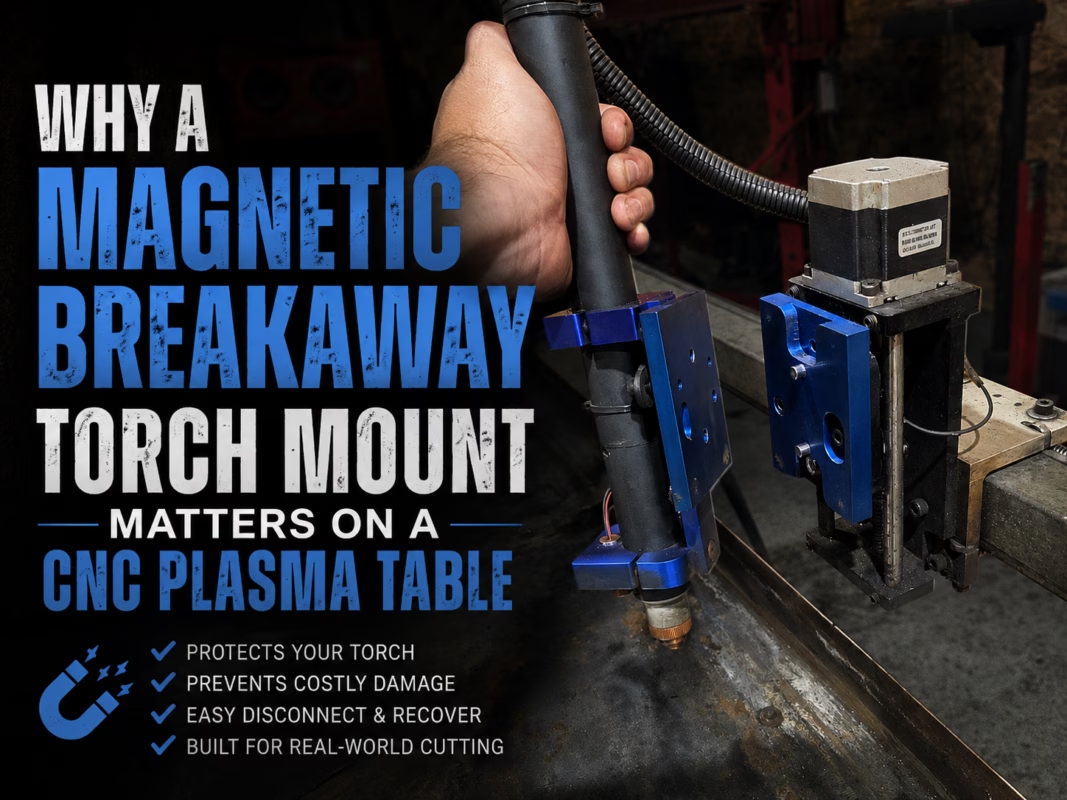
Why a Magnetic Breakaway Torch Mount Matters on a CNC Plasma Table
Sep
Why a Magnetic Breakaway Torch Mount Matters on a CNC Plasma Table
Even with a properly set up CNC plasma table, eventually something is going to go wrong.
A cut part tips up.
A piece of warped material catches the torch.
Slag builds up.
A remnant moves.
The torch travels across something that is no longer where the machine expects it to be.
When that happens, something has to absorb the impact.
A rigidly mounted torch can transfer that force directly into the torch body, holder, Z-axis, gantry, or machine frame.
A magnetic breakaway torch mount gives the system another option:
Let the torch move before something expensive bends or breaks.
What Is a Magnetic Breakaway Torch Mount?
A magnetic breakaway mount connects the torch-holder assembly to the machine using magnetic force rather than making the entire assembly completely rigid during a collision.
During normal cutting, the magnets provide enough holding force to keep the torch securely in position.
But if the torch hits an obstruction hard enough, the mount can release.
Instead of forcing the torch through the obstruction, the holder separates from its normal position.
That can greatly reduce the load transferred into the rest of the machine.
Why Torch Crashes Happen
Torch collisions are not necessarily caused by a poorly programmed machine.
CNC plasma cutting creates a rough environment.
Common causes include:
- Warped sheet metal
- Parts tipping after they are cut free
- Small cutouts standing vertically between the slats
- Heavy slag buildup
- Loose remnants
- Material moving during a cut
- Incorrect torch height
- Unexpected THC movement
- Poor torch-lead routing
- Clamps or fixtures left in the travel path
Even a perfectly programmed toolpath cannot always predict what a loose piece of hot metal is going to do after it is cut free.
Tipped Parts Are One of the Biggest Problems
One of the most common situations is a finished part tipping upward.
The plasma torch cuts the final section of the profile and releases the part from the sheet.
Instead of falling cleanly onto the table, the part rotates and one edge sticks above the material.
The torch then travels toward the next cut.
If that raised edge is in its path, the torch can hit it.
Depending on machine speed and the height of the obstruction, that impact can be surprisingly violent.
What Happens With a Completely Rigid Mount?
If the torch is mounted completely rigidly, the collision force has to go somewhere.
That force can be transferred into:
- The torch body
- Torch-holder components
- Z-axis bearings
- Linear rails
- Gantry components
- Mounting brackets
- Stepper-motor assemblies
The machine may stall or lose position.
In a severe collision, something can bend.
Even if nothing visibly breaks, the machine may no longer be properly aligned.
You may suddenly begin seeing:
- Increased cut bevel
- Poor hole quality
- Inconsistent torch height
- Binding in the Z-axis
- A torch that is no longer square
Now a simple tipped part has turned into a machine-alignment problem.
A Magnetic Mount Provides a Mechanical Escape
A magnetic breakaway mount changes what happens during the collision.
Under normal cutting forces, the holder remains securely attached.
But when the torch experiences a large enough sideways load, the magnetic connection can release.
Instead of transferring the entire collision force into the Z-axis, the torch-holder assembly moves away from its normal position.
It acts almost like a mechanical fuse.
The goal is not to make the torch loose.
The goal is to make the breakaway force lower than the force required to damage the machine.
Protection Without a Complicated Mechanism
One advantage of a magnetic system is its simplicity.
A breakaway mechanism does not necessarily need:
- Springs
- Pneumatic cylinders
- Complicated hinges
- Latches
- Reset levers
The magnetic connection provides both the holding force and the breakaway function.
After a collision, the holder can be repositioned and the machine inspected before cutting continues.
A simple mechanical system is usually easier to understand, maintain, and troubleshoot.
Repeatability Matters
A breakaway mount is only useful if the torch can be returned to its normal position consistently.
After the holder releases, the mounting system should locate the torch back into the same position rather than allowing it to be reinstalled at a random angle.
This matters because torch position affects:
- Squareness
- Cut bevel
- Torch height
- Laser alignment
- Program location
After any collision, the machine should still be checked before production continues, but a repeatable mounting system makes recovery much easier.
A Breakaway Mount Does Not Replace Proper Setup
A magnetic mount should be considered protection against abnormal events.
It should not be used to compensate for:
- Incorrect THC settings
- Poorly routed torch leads
- Excessive material warping
- Bad Z-axis alignment
- Loose machine components
- Improper cut sequencing
The better approach is to prevent crashes whenever possible and use the breakaway mount as a final layer of protection when something unexpected happens.
Torch Lead Routing Still Matters
The previous article covered why torch-lead slack is important on a floating Z-axis.
That also matters with a magnetic breakaway mount.
The torch lead should not constantly pull sideways on the holder.
If the cable is tight enough to apply significant force to the breakaway mount, it can:
- Pull the holder out of position
- Reduce repeatability
- Partially unload the magnetic connection
- Affect the floating Z-axis
- Create inconsistent torch movement
The lead should have enough controlled slack that the mount sees very little force during normal machine movement.
What Should You Do After a Breakaway?
If the torch holder releases during a collision, do not simply snap it back into place and immediately restart the program.
Take a moment to inspect the machine.
Check:
- The obstruction that caused the crash.
- The torch body for visible damage.
- The torch-holder position.
- The magnetic mounting surfaces.
- Torch squareness.
- Z-axis movement.
- Torch-lead routing.
- Consumables.
If the impact was significant, verify the machine has not lost position before continuing.
A breakaway mount can reduce damage, but the collision still happened.
Keep the Magnetic Surfaces Clean
Magnetic mounting surfaces should remain clean.
Slag, grinding dust, steel chips, and debris between the mating surfaces can affect how the mount seats.
Periodically inspect and clean the contact surfaces.
A mount that repeatedly collects debris may not return to the same position as accurately after removal.
Why This Matters More on a Plasma Table
Plasma cutting is different from many other CNC processes because the workpiece itself can change dramatically during the program.
Heat is being added.
Thin material warps.
Small pieces fall through the slats.
Other pieces tip upward.
The environment around the torch is constantly changing.
That makes collision protection particularly valuable.
Rigid While Cutting, Forgiving During a Crash
The ideal torch mounting system needs to accomplish two seemingly opposite things.
During normal cutting it needs to be:
- Secure
- Repeatable
- Square
- Resistant to movement
During a serious collision it should avoid transferring unnecessary force into expensive machine components.
A magnetic breakaway system provides a practical way to achieve both.
Final Thoughts
A CNC plasma torch will eventually encounter something it was not supposed to hit.
The question is what happens next.
With a completely rigid system, the collision force is transferred directly into the torch and machine.
With a magnetic breakaway torch mount, the holder can release before that force becomes destructive.
That can protect:
- The torch
- Torch holder
- Z-axis
- Gantry
- Machine alignment
Keep the torch rigid while it is cutting—and give it somewhere to go when something goes wrong.
