
 Beck’s Toolbox
 Knives
 DIY Build Kits
 Digital Downloads
 Machine Accessories
 Fabricating Materials
CNC Machining
Custom CNC Machining Myths: 7 Things Buyers Get Wrong
Nov
Custom CNC Machining Myths: 7 Things Buyers Get Wrong
CNC machining is used everywhere from small repair shops to aerospace manufacturing, but there is still a surprising amount of misinformation about how the process actually works.
Some of those misconceptions can make a part unnecessarily expensive.
Others can lead to unrealistic expectations about tolerances, surface finish, lead time, or what a CNC machine can physically produce.
If you are ordering custom CNC machining, here are seven myths worth clearing up before you send out your next part.
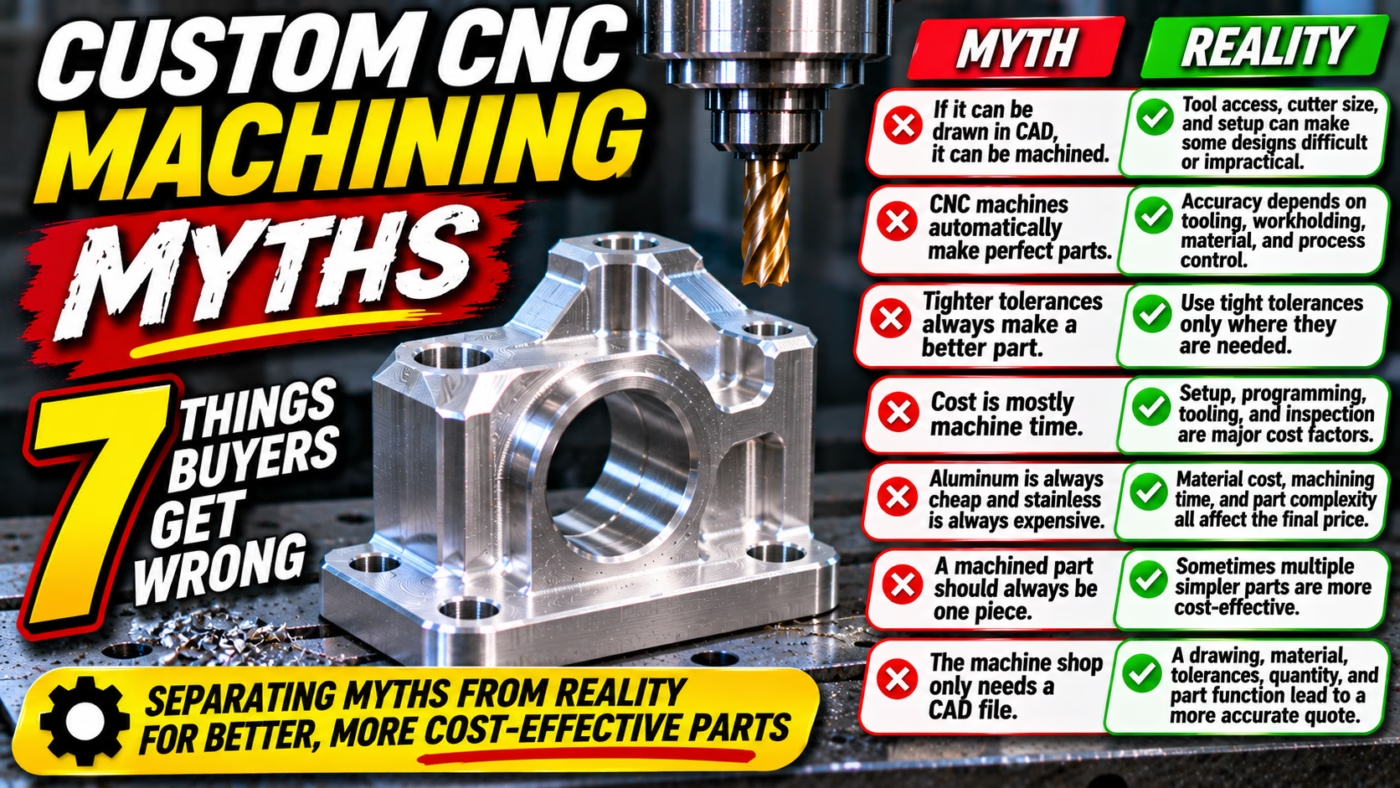
Myth #1: If It Can Be Drawn in CAD, It Can Be Machined
Modern CAD software makes it extremely easy to create complicated geometry.
The cutting tool does not have the same freedom.
A milling cutter has:
- A physical diameter
- A limited cutting length
- A tool holder above it
- A spindle above that
- A finite amount of rigidity
That means certain features can be difficult or impossible to reach.
A deep narrow pocket is a good example.
It might look simple in CAD, but the cutter may need several inches of unsupported length to reach the bottom.
The longer that tool becomes, the more likely it is to deflect or chatter.
Internal corners are another common problem.
A round end mill cannot produce a perfectly sharp inside corner.
The design has to provide enough radius for the cutting tool.
CAD tells you what geometry exists.
It does not automatically tell you whether that geometry is practical to manufacture.
Myth #2: CNC Machines Automatically Produce Perfect Parts
A CNC machine follows programmed coordinates very accurately.
That does not mean the finished part automatically matches the CAD model perfectly.
Real machining involves:
- Tool deflection
- Tool wear
- Cutter runout
- Machine thermal growth
- Workholding distortion
- Material movement
- Cutting forces
- Measurement uncertainty
A machinist has to manage all of those variables.
That may mean roughing a feature first, leaving finishing stock, measuring the part, adjusting tool compensation, and then making a controlled finish pass.
The CNC control is only one part of the process.
Myth #3: Tighter Tolerances Mean a Better Part
This may be the machining myth that costs customers the most money.
A ±0.0005-inch tolerance is not automatically better than ±0.005 inch.
It is only better if the part actually needs it.
Tighter tolerances may require:
- Additional finishing passes
- More frequent inspection
- Better measuring equipment
- More process control
- Additional setup time
- Greater scrap risk
Precision should be placed where the design requires it.
A bearing bore may legitimately require tight control.
A clearance hole for a bolt usually does not need the same tolerance.
The best drawing is not the drawing with the smallest numbers.
It is the drawing that communicates the functional requirements correctly.
Myth #4: CNC Machining Cost Is Mostly Machine Time
A part may physically spend only ten minutes being cut.
That does not mean ten minutes of work went into producing it.
Before the machine ever starts cutting, someone may need to:
- Review the drawing
- Import the CAD model
- Create CAM toolpaths
- Select tools
- Cut raw material
- Set up workholding
- Establish work coordinates
- Measure tools
- Run the first piece
- Inspect the finished part
- Adjust offsets
For a one-off part, all of that work is being spread across one component.
That is why quantity has such a large effect on price.
Once the process is established, the second, tenth, or fiftieth part can often be produced much more efficiently than the first.
Myth #5: Aluminum Is Always Cheap and Stainless Is Always Expensive
Material affects cost, but raw-material price is only one factor.
The real question is how the material behaves throughout the entire manufacturing process.
6061 aluminum usually machines quickly and predictably.
Some stainless steels may require slower cutting conditions and create more heat and tool wear.
But geometry matters too.
A simple stainless component may still be cheaper to produce than an extremely complicated aluminum part.
Material availability also matters.
A common alloy in a standard stock size can sometimes be cheaper overall than an unusual alloy that requires special-order material.
The finished price comes from the entire process, not simply the price per pound.
Myth #6: A Machined Part Should Always Be One Piece
One-piece construction can be excellent.
It can provide rigidity, alignment, and fewer assembly components.
But sometimes it creates unnecessary manufacturing difficulty.
Imagine a large component with deep pockets and features on several sides.
Machining it from one solid billet might require:
- Expensive oversized stock
- Large amounts of material removal
- Several setups
- Long-reach tooling
- Significant machine time
Two simpler machined parts bolted together may perform exactly the same function for less money.
The reverse can also be true.
A fabricated assembly with plates, spacers, welds, and hardware may be better replaced by one machined component.
The right answer depends on the design.
Myth #7: The Machine Shop Only Needs a CAD File
A 3D model is extremely useful, but it does not always tell the entire story.
The CAD model shows nominal geometry.
It may not tell the machinist:
- Which dimensions are critical
- What tolerances are required
- What material you want
- What surface finish matters
- What threads are required
- How many parts you need
- What the component actually does
A good quote package often includes both a STEP model and a drawing.
A short explanation of the part’s function can help too.
If one bore holds a bearing and another hole simply clears a bolt, that is useful information.
The more clearly the functional requirements are communicated, the easier it is to build the right manufacturing process around them.
Good CNC Machining Starts With Good Design
The best machining jobs usually come from designs that understand how parts are actually manufactured.
That means thinking about:
- Tool access
- Workholding
- Standard stock sizes
- Practical corner radii
- Reasonable tolerances
- Number of setups
- Material choice
That does not mean making every part simple.
Complexity is completely justified when it provides a functional benefit.
The goal is eliminating complexity that does nothing.
We Use the Same Approach on Beck Tools Products
The same design-for-manufacturing principles apply to products we build ourselves.
The BA Shredder 2×72 Belt Grinder uses machined components where alignment and mechanical relationships matter.
Our CNC Plasma Machine Torch Holder uses machined full-radius clamping geometry because that shape serves a specific mechanical purpose.
Those features are worth machining accurately because they directly affect how the products function.
That is very different from adding precision or complexity simply because the machine is capable of producing it.
The Bottom Line
CNC machines are extremely capable, but they are not magic.
Good custom CNC machining requires a combination of:
- Good design
- Proper tooling
- Rigid workholding
- Correct programming
- Appropriate materials
- Realistic tolerances
- Reliable inspection
Understanding those limitations does not make CNC machining less impressive.
It makes it much easier to use the process effectively.
If you have a custom component, prototype, replacement part, or short production run you need manufactured, visit our CNC Machining Services page to request a quote.
