
 Beck’s Toolbox
 Knives
 DIY Build Kits
 Digital Downloads
 Machine Accessories
 Fabricating Materials
CNC Machining
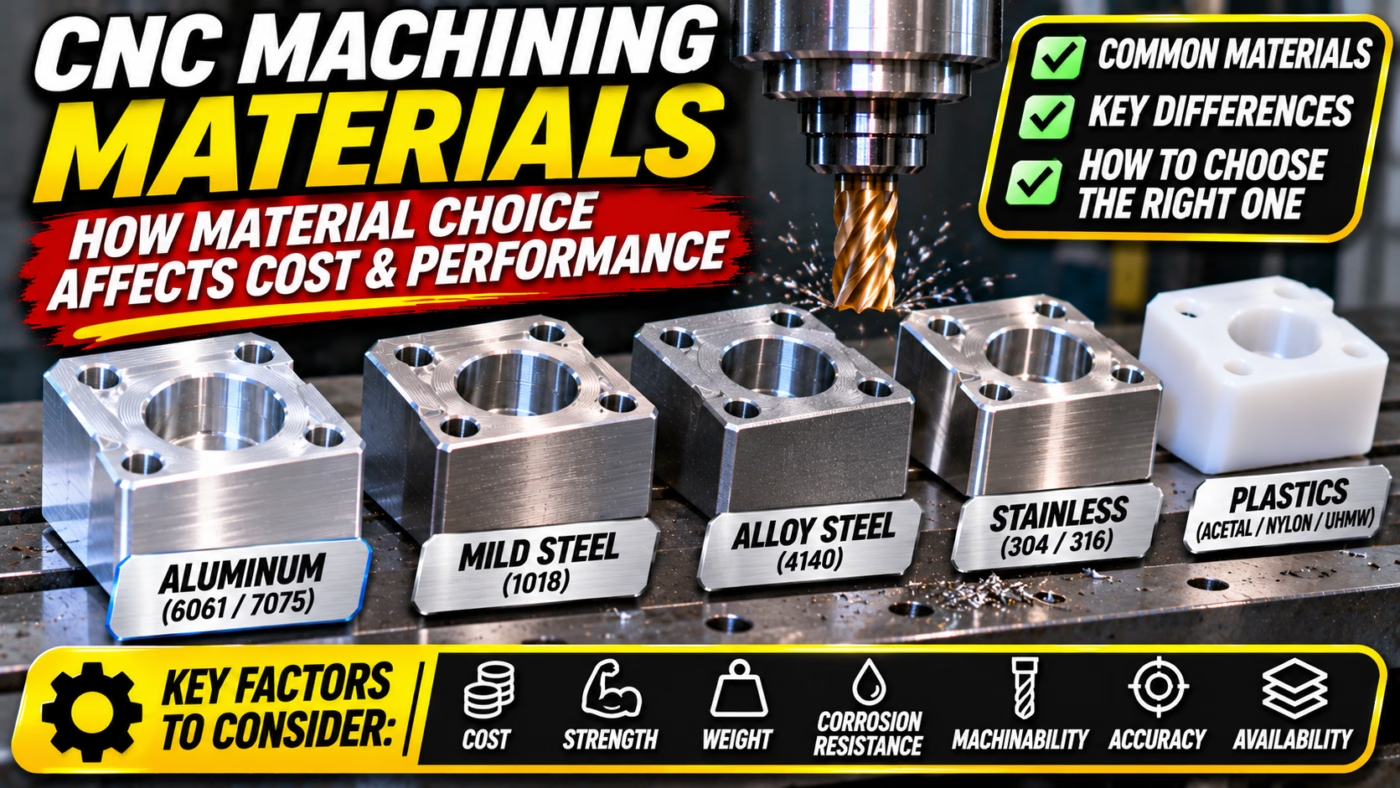
CNC Machining Materials: Aluminum, Steel, Stainless & More
Nov
CNC Machining Materials: How Material Choice Affects Cost and Performance
When someone sends out a part for CNC machining, material is often treated like a simple line item on the drawing.
6061 aluminum.
1018 steel.
304 stainless.
But material selection affects much more than the price of the raw stock.
It changes cutting speed, tool life, workholding, surface finish, distortion, machining time, and sometimes the entire manufacturing strategy.
If you are ordering custom CNC machined parts, choosing the right material can save money while still giving you exactly the strength, corrosion resistance, or wear resistance the part actually needs.
Aluminum Is Popular for a Reason
Aluminum is one of the most common materials for CNC milling.
It is relatively easy to machine, lightweight, corrosion resistant, and available in many standard stock sizes.
For a lot of general-purpose machine components, 6061-T6 aluminum is hard to beat.
Common applications include:
- Brackets
- Fixture components
- Equipment adapters
- Housings
- Mounting plates
- Prototype parts
Because aluminum generally allows higher cutting speeds and removes material efficiently, machining time can be considerably lower than with harder materials.
That can make aluminum attractive even when the raw material itself is not the cheapest option.
6061 vs. 7075 Aluminum
Not all aluminum is the same.
6061 is a good general-purpose alloy with good machinability, corrosion resistance, and strength.
7075 is significantly stronger and is commonly used where higher mechanical strength matters.
But stronger does not automatically mean better.
If a bracket made from 6061 already has plenty of strength, specifying 7075 may simply increase material cost without improving the machine.
Material should be selected around the actual load and environment.
This is the same philosophy we use when designing products such as the BA Shredder 2×72 Belt Grinder: use material properties where they provide a mechanical benefit rather than simply choosing the strongest material available.
Mild Steel Is Strong, Affordable, and Versatile
Mild steels such as 1018 are another common choice for machined parts.
Compared with aluminum, steel provides greater stiffness and strength for the same size component.
That makes it useful for:
- Machine components
- Shafts
- Clamping components
- Tooling
- Wear-resistant structures
- High-load brackets
Steel is generally slower to machine than aluminum, but it can be a better choice when rigidity or strength matters.
A component that would need to be large and bulky in aluminum may be more compact in steel.
So the cheapest material per pound is not necessarily the cheapest finished design.
A36 and 1018 Are Not Interchangeable Just Because They Are Both Mild Steel
This is something worth understanding when designing machined parts.
A36 is commonly used for structural plate and fabrication.
1018 cold-finished steel is generally much more predictable for precision machining.
Cold-finished material usually provides better dimensional consistency, surface condition, and mechanical-property consistency than typical hot-rolled structural material.
That does not mean A36 cannot be machined.
It absolutely can.
But if I am making a precision machine component, I would normally prefer a material selected for machining rather than simply using whatever mild-steel plate is cheapest.
Stainless Steel Can Increase Machining Cost Quickly
Stainless steel is useful when corrosion resistance matters.
It can also be much less forgiving to machine than aluminum or mild steel.
Certain stainless alloys work harden.
That means poor cutting conditions can actually make the material at the cutting zone harder as you machine it.
The machinist has to maintain appropriate chip load, tooling, and cutting conditions rather than rubbing the cutter against the material.
Stainless can also generate more heat and increase tool wear.
That means a part that looks identical in CAD can cost considerably more in stainless than in aluminum.
If the part truly needs corrosion resistance, that cost may be completely justified.
If it lives indoors in a dry machine and gets painted anyway, stainless may provide very little benefit.
4140 Makes Sense When Strength and Wear Matter
4140 alloy steel is a useful material for higher-load components.
It is commonly used for:
- Shafts
- Pins
- Tooling
- Machine components
- High-load fixtures
- Wear components
It is also available pre-hardened, often called 4140 pre-hard or 4140 HT.
That can be extremely useful because the part already has increased hardness and strength before machining.
The tradeoff is that harder material is more demanding on cutting tools.
Machining 4140 pre-hard is very different from machining 6061 aluminum.
Again, the material should earn its place in the design.
Plastics Can Be Excellent CNC Materials
CNC machining is not limited to metal.
Engineering plastics can be an excellent choice for:
- Guides
- Bushings
- Wear strips
- Electrical components
- Low-friction parts
- Lightweight fixtures
Common machinable plastics include:
- Acetal
- Nylon
- UHMW
- HDPE
- Polycarbonate
Plastics introduce their own challenges.
Some move significantly with temperature.
Others can distort from clamping pressure or internal stress.
They may also require different cutting strategies to control heat and chip evacuation.
Just because a material is soft does not mean dimensional accuracy is automatic.
Material Strength Is Only One Design Requirement
When choosing material, designers tend to focus heavily on tensile or yield strength.
Those numbers matter, but they are only part of the decision.
You may also need to consider:
- Stiffness
- Hardness
- Wear resistance
- Corrosion resistance
- Weight
- Thermal expansion
- Weldability
- Availability
- Surface treatment
- Machinability
For example, aluminum may have sufficient strength for a fixture plate, but steel might provide better rigidity.
A stainless component may resist corrosion beautifully, but a coated carbon-steel part might perform equally well for much less money.
There is rarely one material property that determines everything.
Stock Size Can Matter as Much as Alloy
Suppose your
