
 Beck’s Toolbox
 Knives
 DIY Build Kits
 Digital Downloads
 Machine Accessories
 Fabricating Materials
CNC Machining
CNC Tool Runout: Why It Destroys End Mill Life
Nov
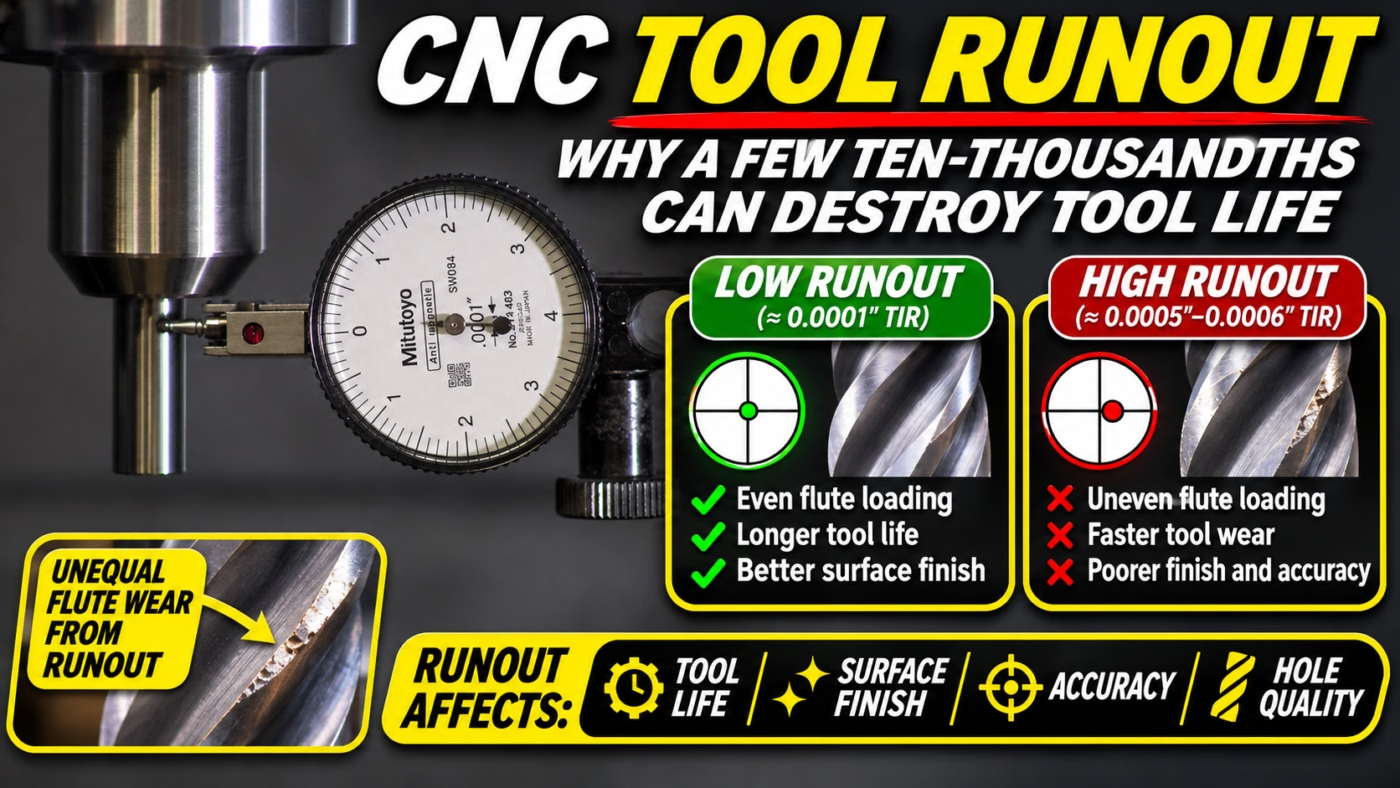
CNC Tool Runout: Why a Few Ten-Thousandths Can Destroy Tool Life
You can buy a premium carbide end mill, use the manufacturer’s recommended feeds and speeds, and still get terrible tool life.
The cutter may not be the problem.
The problem could be tool runout.
Runout causes the cutting tool to rotate slightly off center. Instead of every flute sharing the cutting load equally, one or two flutes can end up doing considerably more work than the others.
The scary part is that the amount of runout required to create problems can be extremely small.
We are talking about a few ten-thousandths of an inch.
What Is Tool Runout?
Ideally, the cutting tool rotates perfectly around its own centerline.
In reality, the tool can orbit slightly as it rotates.
That movement is commonly measured as Total Indicator Runout, or TIR.
If you place an indicator against the tool and slowly rotate the spindle, the difference between the highest and lowest indicator reading is the measured TIR.
For example:
Highest reading: +0.0002 inch
Lowest reading: -0.0002 inch
That represents:
0.0004 inch TIR
Four ten-thousandths does not sound like much.
For a small carbide end mill, it can be significant.
Runout Changes the Chip Load on Every Flute
Suppose you have a four-flute end mill programmed for a chip load of:
0.002 inch per tooth
In a perfect setup, each flute removes approximately the same amount of material.
Now introduce enough runout that one cutting edge sits farther from the tool centerline than the others.
That flute enters the material first.
It takes a thicker chip.
The opposite flute may take a much smaller chip—or potentially do very little cutting at all.
Your CAM program still thinks you are feeding every flute at 0.002 inch per tooth.
The cutting edges disagree.
This is one reason feeds and speeds cannot be separated from the mechanical condition of the tooling system.
A Four-Flute Cutter May Not Really Be Cutting With Four Flutes
BIG DAISHOWA explains that when a tool does not run concentrically, cutting forces are concentrated on the flute sitting farthest from the centerline.
Instead of all cutting edges sharing the work, certain flutes carry a disproportionate amount of the load.
That creates uneven wear.
Inspect a worn end mill and you may find one flute noticeably more damaged than the others.
That is a major clue.
Before blaming the carbide, coating, or feeds and speeds, check the runout.
BIG DAISHOWA’s Testing Shows How Much Runout Matters
BIG DAISHOWA tested a four-flute, 10 mm carbide end mill at several runout levels.
Reducing runout from approximately 0.0006 inch to 0.00008 inch increased cutting length from about 528 feet to 693 feet—roughly a 30% increase in cutting length.
Their explanation is straightforward: lower runout distributes the cutting forces more evenly across the flutes.
They also report that around 0.0005 inch TIR, which many shops may consider acceptable, tool-life efficiency can already be roughly half of what is possible at extremely low runout.
That is a substantial difference caused by only a few ten-thousandths of an inch.
Small End Mills Are Even More Sensitive
Runout becomes increasingly important as cutter diameter decreases.
Think about a 1/2-inch end mill running a 0.004-inch chip load.
A few ten-thousandths of runout represent a relatively small percentage of the programmed chip load.
Now consider a small cutter running a chip load of only:
0.0005 inch per tooth
If the tooling system has 0.0004 inch of runout, the runout is nearly as large as the programmed chip load.
One flute may be getting hammered while another barely cuts.
BIG DAISHOWA specifically notes that allowable runout needs to become tighter as cutter diameter and chip load decrease.
This is why micro end mills and small drills demand extremely good tooling.
Carbide Is Particularly Sensitive to Runout
Carbide is extremely hard and wear resistant.
It is also relatively brittle.
BIG DAISHOWA tested carbide drills at different runout levels and found dramatic reductions in tool life as runout increased.
In one test, improving runout from 0.0006 inch to 0.00008 inch roughly tripled the life of a 3 mm solid-carbide drill.
That does not mean every carbide tool will triple its life if you buy a better holder.
Cutting conditions, tool geometry, material, and application all matter.
But the testing clearly demonstrates how sensitive carbide can be to uneven loading.
Runout Can Hurt Surface Finish Too
Uneven flute engagement does more than wear out the cutter.
It can leave an inconsistent surface.
If one flute is cutting deeper than the others, the actual cutting path changes as the tool rotates.
BIG DAISHOWA’s testing found that reducing runout helped stabilize flute loading and produced a finer surface finish.
This becomes especially important during finishing operations where you are expecting all cutting edges to produce a consistent surface.
Runout Can Affect Hole Size
Runout is also important when drilling and reaming.
If a drill is rotating off-center, the effective cutting diameter can become larger than the actual drill diameter.
The tool can also experience uneven radial forces.
That can contribute to:
- Oversized holes
- Poor roundness
- Uneven tool wear
- Reduced drill life
Reamers are particularly dependent on concentricity because the entire purpose of the tool is producing a controlled finished hole.
REGO-FIX specifically promotes low-TIR toolholding for drills, reamers, and end mills because of the relationship between concentricity, tool life, and finished-part quality.
Where Does Runout Come From?
This is where troubleshooting gets interesting.
Runout is not necessarily caused by one component.
The entire stack matters.
Potential sources include:
- Machine spindle
- Spindle taper
- Toolholder taper
- Toolholder bore
- Collet
- Clamping nut
- Cutting-tool shank
- Dirt or chips between mating surfaces
Every interface contributes to the final position of the cutter.
This means replacing the end mill may do absolutely nothing if the real problem is elsewhere.
Clean Tooling Matters
A tiny chip or piece of contamination between precision surfaces can move the tool.
That includes contamination:
- Inside a collet
- Between the collet and holder
- On the tool shank
- On the machine taper
- On the toolholder taper
Precision toolholding depends on clean mating surfaces.
Before deciding a holder is bad, clean everything carefully and measure again.
This costs almost nothing and should be one of the first troubleshooting steps.
Toolholder Quality Matters
Toolholders are not simply devices that prevent the end mill from falling out of the spindle.
They directly affect the position and stability of the cutting tool.
HAIMER publishes runout specifications around 0.003 mm, or roughly 0.00012 inch, at 3× diameter for many of its higher-precision shrink-fit, hydraulic, and precision collet systems.
REGO-FIX likewise emphasizes low TIR throughout its collet and powRgrip systems.
That level of precision is not marketing trivia.
It directly affects the cutting tool.
ER Collets Can Be Very Accurate—If the Whole System Is Good
There is sometimes a misconception that ER collets are inherently inaccurate.
A quality ER system can be extremely accurate.
The important word is system.
You need:
- Accurate holder
- Quality collet
- Proper nut
- Clean mating surfaces
- Correct tightening procedure
- Good cutting-tool shank
Installing an expensive precision collet into a poor-quality holder does not magically create a precision assembly.
Likewise, a perfect holder cannot correct a damaged tool shank.
Side-Lock Holders Trade Precision for Clamping Strength and Simplicity
Weldon or side-lock holders physically clamp against a flat on the tool.
They are simple and can transfer substantial torque.
But depending on the design and quality, pushing the tool against one side of the bore can create more runout than a high-quality concentric clamping system.
REGO-FIX has published comparisons showing significantly higher typical TIR for conventional side-lock holders than its precision ER systems.
That does not mean side-lock holders are bad.
A heavy roughing operation using a large end mill has very different requirements from a 1/8-inch carbide finishing cutter.
Choose the holder for the application.
Shrink-Fit Holders Are Popular for a Reason
Shrink-fit holders heat the toolholder so its bore expands.
The cutting tool is inserted.
As the holder cools, it contracts around the shank.
This provides excellent concentricity with a relatively simple, rigid geometry.
HAIMER specifies runout around 0.003 mm for its shrink-fit systems and lists them for drilling, finishing, high-speed cutting, and other applications depending on holder design.
Shrink fit is especially attractive for high-speed machining because the holder can be compact, rigid, and well balanced.
The disadvantage is that you need the proper heating equipment to change tools.
Hydraulic Chucks Are Another Precision Option
Hydraulic toolholders use hydraulic pressure inside the holder body to clamp the cutting-tool shank.
They can provide:
- Low runout
- Good vibration damping
- Easy tool changes
HAIMER also publishes approximately 0.003 mm runout for its hydraulic chuck systems in applicable configurations.
Again, there is no universal best toolholder.
Roughing, high-speed finishing, drilling, micro machining, and heavy torque applications can benefit from different systems.
Measure the Complete Assembly
If you are troubleshooting runout, do not immediately condemn the holder.
Work backward.
Measure:
- The cutting tool near the holder.
- The cutting tool farther down the shank if practical.
- Another known-good tool in the same holder.
- The holder with another collet.
- The machine spindle using an appropriate test bar if necessary.
This helps separate:
Tool problem
from
Collet problem
from
Holder problem
from
Spindle problem.
Replacing parts randomly can get expensive very quickly.
Measure Close to Where the Cutting Happens
Runout measured directly beside the holder and runout measured several inches away may not be identical.
Any angular error becomes more noticeable as you measure farther from the holder.
This is why tooling manufacturers often specify runout at a defined distance such as 3× tool diameter.
HAIMER’s published toolholder comparisons, for example, specify their measurements at 3×D.
A runout number without knowing where it was measured does not tell the complete story.
Do Not Ignore the Spindle
You can buy the most accurate holder available and still have runout if the spindle itself has a problem.
BIG DAISHOWA specifically notes that even a high-quality holder cannot overcome a worn or inaccurate spindle.
Possible spindle-related causes include:
- Worn bearings
- Damaged taper
- Contamination
- Tool-change damage
- Improper drawbar retention
- Spindle geometry problems
If several different holders show similar runout in the same direction, start looking upstream.
Runout Is Especially Important at High RPM
High-speed machining makes toolholder quality even more important.
At higher spindle speeds, imbalance and dynamic behavior become increasingly significant.
BIG DAISHOWA distinguishes between static runout and dynamic runout—what happens while the spindle is actually rotating at operating speed.
Its high-speed spindle systems specifically emphasize dynamic runout because micro tools operating at tens of thousands of RPM are extremely sensitive to small errors.
A tool that measures beautifully while stationary may not behave exactly the same at 30,000 RPM.
Do You Need Ultra-Precision Holders for Everything?
No.
This is where common sense matters.
If you are roughing mild steel with a 3/4-inch end mill, chasing 0.00005 inch of runout may provide very little return compared with other limitations in the process.
If you are running a 1/16-inch carbide end mill, the situation changes dramatically.
The acceptable runout should be considered relative to:
- Tool diameter
- Chip load
- Required tolerance
- Surface finish
- Tool cost
- Spindle speed
Spend precision where the process can actually benefit from it.
A Cheap Holder Can Become Expensive
This is probably the most important economic lesson.
Imagine saving $60 on a toolholder.
Then every $50 carbide end mill lasts half as long.
The inexpensive holder is no longer inexpensive.
BIG DAISHOWA and REGO-FIX both publish examples showing how reducing runout can substantially increase cutting-tool life and reduce tooling cost.
When comparing holders, look beyond the purchase price.
Consider the cost of the entire machining process.
Runout Matters on the Parts We Manufacture
These same principles apply to the parts we machine at Beck Tools.
The bearing locations and running geometry of the CNC-machined wheels in our Belt Grinder Wheel Kit depend on a stable machining process.
The machined components throughout the BA Shredder 2×72 Belt Grinder similarly depend on the cutting tool actually following the path we programmed.
Good tooling does not replace good programming.
It makes it possible for the cutter to execute that program consistently.
A Practical Runout Troubleshooting Checklist
If your end mills are wearing unevenly, breaking prematurely, or suddenly producing poor finishes, I would check:
- Is the tool shank clean?
- Is the collet clean?
- Is the holder clean?
- Is the spindle taper clean?
- Does another end mill show the same runout?
- Does another collet show the same runout?
- Does another holder show the same problem?
- Does the spindle itself test correctly?
- Is the tool sticking out farther than necessary?
- Is the measured runout reasonable compared with the programmed chip load?
Do not immediately assume the cutting parameters are wrong.
The tool may simply not be rotating where you think it is.
Manufacturer Resources Worth Reading
For more technical information on toolholding and runout, these manufacturer resources are worth reviewing:
BIG DAISHOWA — Riding Herd on Runout BIG DAISHOWA runout testing
BIG DAISHOWA — Combat Rising Carbide Costs with Better Tool Holders BIG DAISHOWA toolholder and end-mill testing
HAIMER — Overview of Tool Holder Technology HAIMER toolholder guide
REGO-FIX — Toolholding and runout information REGO-FIX toolholding systems
The Bottom Line
Tool runout can quietly destroy tool life.
A few ten-thousandths of an inch may be enough to make one flute carry considerably more load than the others—especially on small cutters and low chip-load applications.
That can affect:
- Tool life
- Surface finish
- Hole size
- Dimensional accuracy
- Cutting stability
- Tooling cost
If a premium carbide end mill is not performing the way you expect, do not immediately blame the cutter.
Measure the complete system.
The spindle, holder, collet, cutting tool, cleanliness, tool stickout, and operating conditions all contribute to where the cutting edge actually runs.
Sometimes the best way to make an end mill last longer is not buying a better end mill.
It is holding the one you already have more accurately.
If you need a custom component, prototype, replacement part, or short production run manufactured, visit our CNC Machining Services page to request a quote.
