
 Beck’s Toolbox
 Knives
 DIY Build Kits
 Digital Downloads
 Machine Accessories
 Fabricating Materials
CNC Machining
Why CNC Machined Parts Cost What They Cost
Nov
Why CNC Machined Parts Cost What They Cost
One of the biggest misconceptions about CNC machining is that the cost of a part should be based mostly on how long the machine spends cutting it.
People sometimes look at a relatively simple part and think:
“That probably only takes five minutes to machine. Why does it cost that much?”
The problem is that cycle time is only one piece of the job.
For custom CNC machined parts, especially prototypes and short production runs, setup, programming, workholding, material preparation, inspection, tooling, and secondary operations can easily matter more than the actual cutting time.
Understanding where that cost comes from can also help you design parts that are less expensive to manufacture without sacrificing function.
CNC Machining Is More Than Pressing Cycle Start
Once a CNC program is proven, the stock is loaded, the tools are set, and everything is dialed in, running another part can sometimes be relatively fast.
Getting to that point takes work.
Before the first finished part comes off the machine, a machinist may need to:
- Review the drawing or CAD model
- Determine how the part will be held
- Select raw material
- Saw material to size
- Program the machining operations
- Select cutting tools
- Build or modify workholding
- Set tool lengths
- Establish work offsets
- Machine the first part
- Measure critical dimensions
- Adjust offsets
- Deburr and inspect the finished component
That work has to happen whether you order one part or one hundred.
This is why quantity has such a large effect on the price per part.
Setup Time Is a Major Cost on Short Runs
Suppose a part requires two hours of programming and setup but only ten minutes of machine time.
If you need one part, all two hours of setup belong to that one part.
If you need fifty parts, the same setup cost is distributed across fifty pieces.
That is why a one-off CNC machined component can appear expensive compared with a production part.
It is not necessarily because the machine shop is charging an unreasonable amount for ten minutes of cutting.
You are paying to establish the entire manufacturing process.
This is also why combining several identical parts into one order can dramatically reduce the cost per piece.
Multiple Setups Can Make a Simple Part Expensive
A part does not have to look complicated to require a lot of work.
Imagine a rectangular block with features on the top, bottom, and both ends.
The geometry itself might be simple.
But every time the part needs to be repositioned, the machinist has to create another controlled setup.
That can mean:
- Re-clamping the part
- Establishing a new work coordinate
- Making sure the part is square
- Verifying its position
- Running another group of machining operations
A part requiring four setups can cost considerably more than another part with similar geometry that can be completed in one or two.
This is one reason designing features so they can be reached from the same direction can reduce machining cost.
Tight Tolerances Increase Cost
A ±0.010-inch dimension and a ±0.0005-inch dimension are not the same manufacturing problem.
The tighter the tolerance, the more attention may be required for:
- Tool wear
- Machine temperature
- Cutter deflection
- Workholding
- Finishing passes
- Measurement
- Inspection frequency
This does not mean tight tolerances are bad.
Sometimes they are absolutely necessary.
A bearing bore, dowel-pin location, or precision shaft fit may legitimately require very tight control.
The problem is applying those tolerances to features that do not need them.
If a clearance hole for a bolt works perfectly with a generous tolerance, specifying an extremely tight one only adds cost.
That is why good CNC part design puts precision where it matters instead of applying it everywhere.
Material Affects More Than Raw Material Cost
People understandably think about material cost in terms of the price of the metal itself.
But different materials also machine differently.
Some materials allow aggressive cutting speeds and predictable tool life.
Others generate more heat, wear tools faster, require slower cutting conditions, or create difficult chips.
Material availability also matters.
If your part requires a piece of stock that is not commonly available, the shop may have to purchase a larger piece than your finished component requires.
For a one-off job, you may effectively be paying for material that becomes leftover stock.
Selecting a commonly available material and stock size can sometimes reduce cost before machining even begins.
Tool Access Makes a Big Difference
A feature may be easy to draw in CAD but difficult to reach with a cutting tool.
Deep narrow pockets are a good example.
The deeper the cutter has to reach, the longer and less rigid the tool becomes.
Long tools are more prone to:
- Deflection
- Chatter
- Reduced cutting speeds
- Poor surface finish
- Tool breakage
Very small internal corner radii create a similar problem.
If the part does not actually require a tiny radius, allowing a larger corner radius lets the machinist use a larger, stronger cutting tool.
That can remove material faster and improve tool life.
Sometimes changing one radius on a drawing can make a surprising difference in manufacturing cost.
Every Tool Change Adds Something
A complicated part may require:
- Face mills
- End mills
- Drills
- Spot drills
- Chamfer tools
- Reamers
- Boring tools
- Thread mills
- Taps
Modern CNC machines make tool changes automatically, but the tools still have to be selected, loaded, measured, programmed, and maintained.
Special features may require tooling that the shop does not normally keep on hand.
If a job requires a specialty cutter for one feature, that tooling cost ultimately becomes part of producing the component.
Using common hole sizes, practical radii, and standard threads can help avoid unnecessary specialty tooling.
Inspection Is Part of Manufacturing
A part is not finished simply because the machine stopped running.
Critical dimensions have to be verified.
Depending on the component, that could involve:
- Calipers
- Micrometers
- Bore gauges
- Height gauges
- Indicators
- Gauge pins
- Thread gauges
- Other inspection equipment
The tighter and more numerous the critical dimensions become, the more inspection time may be required.
Again, that does not mean you should remove necessary tolerances.
It means the drawing should clearly distinguish between dimensions that truly matter and dimensions where normal machining variation is acceptable.
One-Off Replacement Parts Have Their Own Challenges
Replacement components can involve additional work because sometimes there is no drawing.
The customer may bring in a worn or broken part and say:
“Can you make another one of these?”
Now the job may include reverse engineering.
Dimensions need to be measured, original design intent has to be determined, and wear has to be separated from the geometry the part originally had.
In some cases, producing the replacement part is the easy part.
Figuring out what the replacement part should actually look like takes more time.
This is exactly the type of work where experience with machine design and manufacturing becomes valuable.
Beck Tools offers CNC machining services for custom components, prototypes, replacement parts, and short production runs.
Real Products Show Why Manufacturing Decisions Matter
The same principles apply to products we manufacture for Beck Tools.
Our BA Shredder 2×72 Belt Grinder uses machined components where alignment and function matter, but there is no advantage to unnecessarily tightening every dimension on the machine.
Our CNC Plasma Machine Torch Holder is another good example. Its machined full-radius clamping surfaces need to fit and support the torch correctly. Those relationships matter mechanically, so that is where manufacturing accuracy earns its keep.
Good product design is not about making everything difficult to manufacture.
It is about knowing which features actually need precision.
How to Make Custom CNC Parts Less Expensive
If you are designing a part that will be CNC machined, a few decisions can have a large effect on cost.
Try to:
- Use reasonable tolerances.
- Avoid unnecessarily deep pockets.
- Allow practical internal corner radii.
- Use common material sizes.
- Use standard hole and thread sizes where possible.
- Reduce the number of required setups.
- Provide clear drawings for critical features.
- Order multiple parts at once when you know you will need them.
None of these changes require sacrificing the function of the part.
In many cases, they simply remove manufacturing requirements that were never needed in the first place.
The Bottom Line
The cost of a CNC machined part is not determined by cycle time alone.
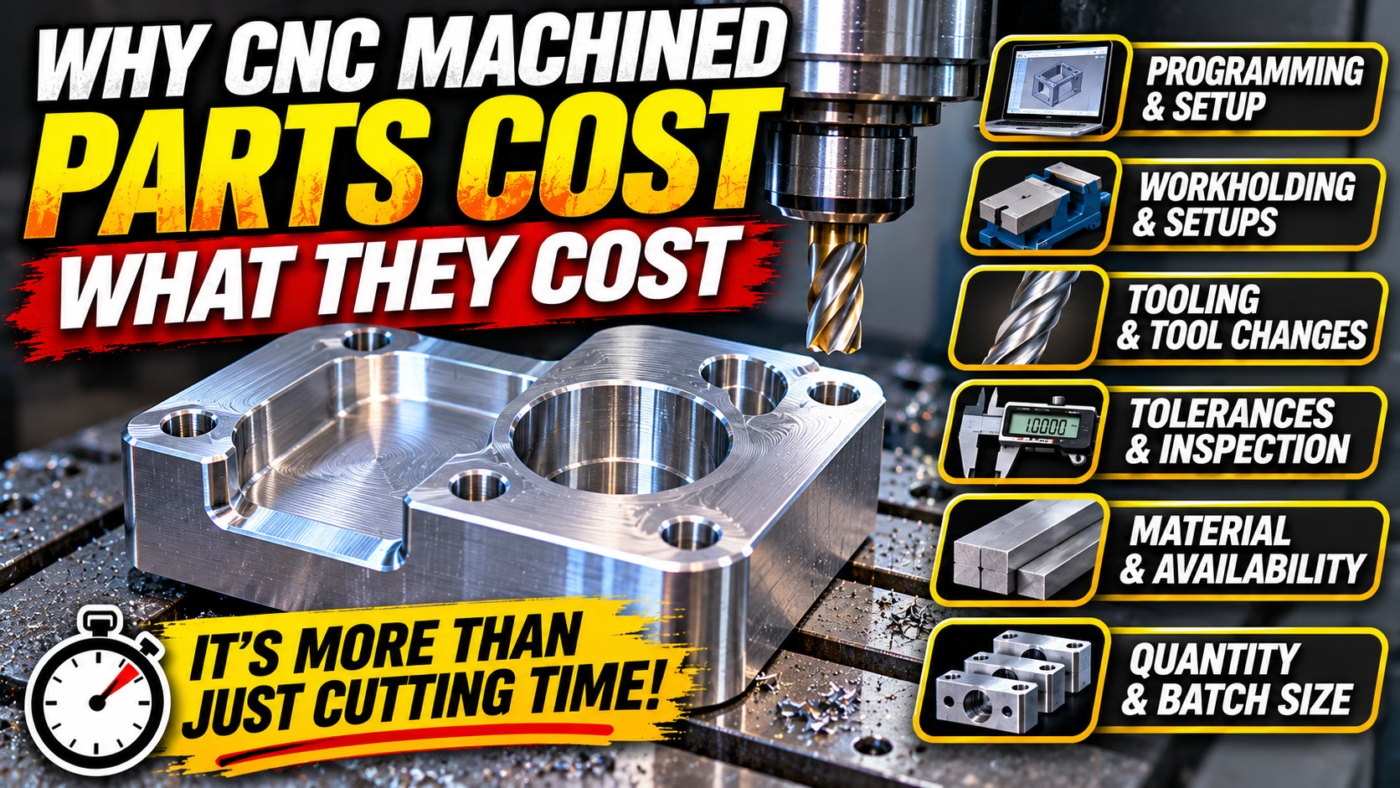
Programming, setup, workholding, material, tooling, tolerances, inspection, and quantity all contribute to the final price.
That is why a part that takes ten minutes to physically cut can still represent several hours of manufacturing work.
The best way to control CNC machining cost is not simply finding someone willing to run the machine cheaper.
It is designing the part intelligently and choosing a manufacturing process that produces the required function without adding unnecessary complexity.
If you have a custom part, prototype, replacement component, or short production run you need manufactured, visit our CNC Machining Services page to request a quote.
