
 Beck’s Toolbox
 Knives
 DIY Build Kits
 Digital Downloads
 Machine Accessories
 Fabricating Materials
CNC Machining
Custom CNC Parts: 8 Ways to Reduce Machining Cost
Nov
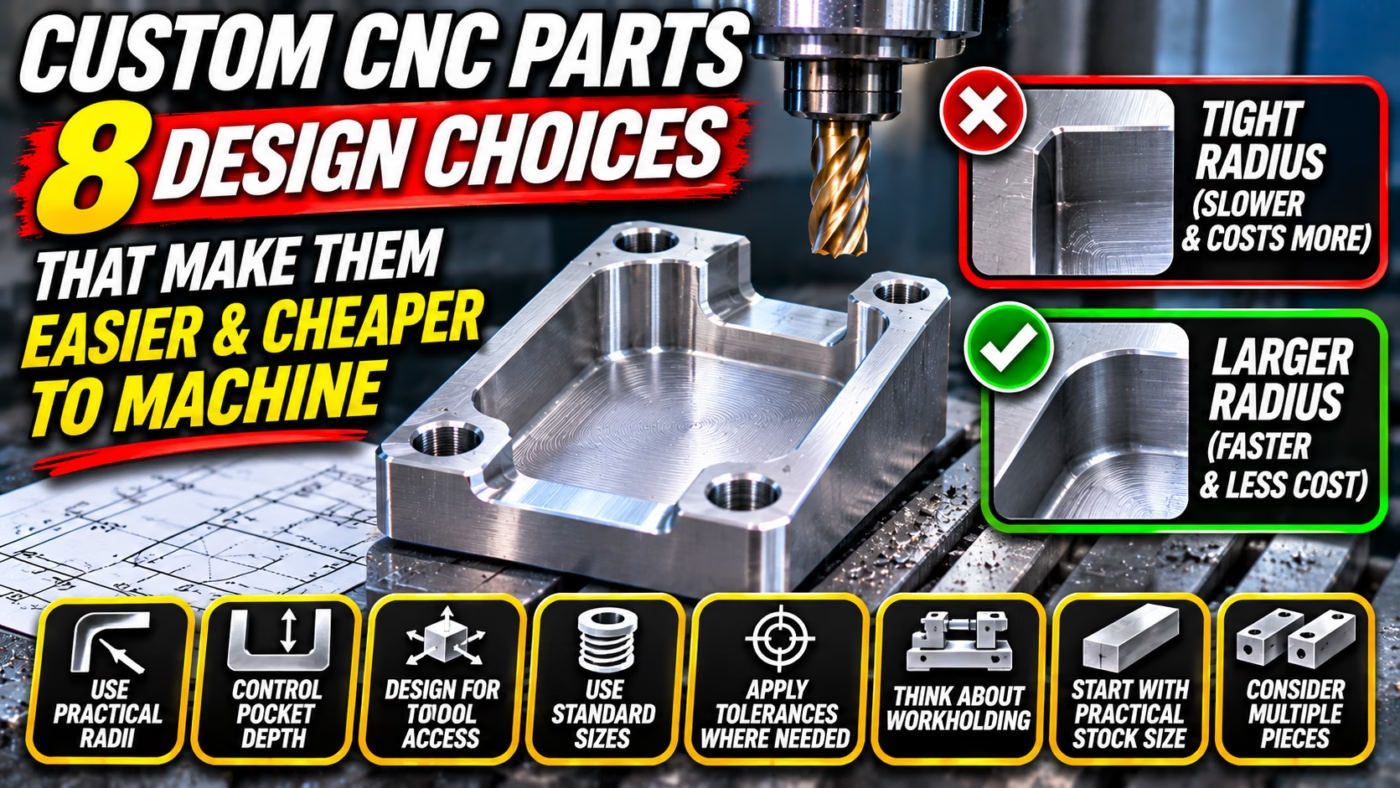
Custom CNC Parts: 8 Design Choices That Make Them Easier and Cheaper to Machine
A lot of CNC machining cost is determined before the machinist ever touches the machine.
It is determined in the design.
Two parts can perform exactly the same job while one is dramatically easier and cheaper to manufacture than the other.
That does not mean every component should be simplified until it becomes crude. It means designing the part around what it actually needs to do instead of creating manufacturing difficulty that provides no benefit.
If you are designing custom CNC parts, here are eight things I would look at before sending the model out for a quote.
1. Avoid Tiny Internal Corner Radii
This is one of the easiest ways to make a milled part unnecessarily difficult.
A CNC end mill is round, so it cannot create a perfectly sharp internal corner.
If you specify a very small internal radius, the machinist has to use a very small cutter.
Smaller cutters generally mean:
- Less rigidity
- Lower material-removal rates
- More deflection
- Greater risk of tool breakage
- Longer machining time
If the mating component does not actually require a tiny corner radius, give the machinist room to use a larger tool.
Sometimes increasing an internal radius by a small amount can make a substantial difference in how efficiently the pocket can be machined.
2. Deep Pockets Get Expensive Fast
Deep pockets look simple in CAD.
They are not always simple to machine.
The deeper the pocket becomes, the farther the cutting tool has to stick out of the holder.
That reduces rigidity.
Now the machinist may have to reduce depth of cut, reduce feed rate, use multiple tools, or make additional finishing passes to control chatter and deflection.
A wide, shallow pocket is generally much easier to machine than a narrow pocket several inches deep.
If the depth is genuinely necessary, that is fine.
But if a design can be changed to reduce the reach without affecting the function, it is worth considering.
3. Design Features From Accessible Directions
Every time a part has to be removed, repositioned, indicated, and machined from another direction, you have added another setup.
Setups cost money.
Imagine a block with holes on the top, both sides, and the bottom.
The features themselves might be easy to machine, but the part may need several separate operations to reach them.
If some of those features can be moved or redesigned so they are accessible from the same direction, the machining process may become much simpler.
This is especially important for prototypes and short runs because setup time is spread across relatively few parts.
4. Use Standard Hole and Thread Sizes
There is usually no advantage to making a hole or thread unusual unless the design actually requires it.
Standard sizes mean the shop is more likely to already have the necessary drills, taps, reamers, and gauges.
An unusual thread or odd-size precision bore may require special tooling.
That tooling becomes part of the cost of producing your custom CNC parts.
Whenever practical, use common:
- Screw threads
- Clearance holes
- Tapped holes
- Reamed hole sizes
- Counterbores
- Countersinks
Standard components are usually easier to replace later, too.
5. Do Not Add Precision Everywhere
A common misconception is that a more accurate drawing is automatically a better drawing.
It is not.
Precision should be applied where it affects function.
A bearing bore may need to be tightly controlled.
A clearance hole for a mounting bolt probably does not need the same level of precision.
If every feature is held to an extremely tight tolerance, the machinist has to treat the entire part as critical.
That can mean more finishing operations, more inspection, more adjustments, and more scrap risk.
Put tight tolerances where they earn their keep.
For a deeper explanation, see our guide on CNC machining tolerances and why tighter is not always better.
6. Think About How the Part Will Be Held
Workholding is easy to forget when designing a component.
The machinist still has to physically hold the material while cutting it.
If nearly every surface needs machining, eventually the shop has to figure out how to hold the part without covering the features that still need to be cut.
Sometimes that requires:
- Custom fixture plates
- Soft jaws
- Machined locating features
- Additional material for clamping
- Multiple operations
Adding a small amount of sacrificial material or providing practical clamping surfaces can make a difficult part considerably easier to manufacture.
Good workholding also improves repeatability.
7. Start With a Practical Stock Size
A finished part measuring 1.010 inches thick may sound reasonable.
But if commonly available stock is 1.000 or 1.250 inches thick, that extra 0.010 inch can create a surprising amount of additional machining.
The shop may need to start with 1.250-inch material and remove nearly a quarter inch of stock from the entire part.
Sometimes there is a functional reason for that dimension.
Sometimes there is not.
Knowing common material sizes can help you design around stock that is easier and less wasteful to process.
This matters even more when the part is large because the amount of material being removed can become significant.
8. Consider Whether the Part Really Needs to Be One Piece
CNC machining allows designers to make some incredibly complicated parts.
That does not mean they should.
Sometimes one elaborate component is more expensive to manufacture than two simple components that bolt together.
Breaking a design into multiple pieces can:
- Improve tool access
- Reduce setup count
- Eliminate deep pockets
- Reduce material waste
- Make individual components easier to replace
Of course, splitting a component also introduces fasteners, assembly time, alignment concerns, and additional interfaces.
The point is not that multiple pieces are always better.
The point is that one-piece construction is not automatically the best design.
Design for Function First, Then Manufacturability
Design for manufacturing does not mean allowing the manufacturing process to dictate everything about the product.
The part still has to do its job.
At Beck Tools, we deal with this same balance in our own products.
The BA Shredder 2×72 Belt Grinder uses machined components where alignment and rigidity matter. Those features need to be controlled accurately, while other dimensions can remain practical to manufacture.
The same applies to our CNC Plasma Machine Torch Holder. The full-radius clamping geometry has an actual mechanical purpose, so that is where manufacturing accuracy matters.
That is the basic philosophy I use when designing parts:
Spend precision and complexity where they improve the function of the machine.
Do not spend them simply because the CAD software makes complicated geometry easy to draw.
Talk to Your Machine Shop Early
If you are working on an expensive or complicated component, it can be worth getting manufacturing input before the drawing is completely finished.
A machinist may look at the model and immediately see something that could save an hour of machining.
Maybe one radius can increase.
Maybe a feature can be reached from the opposite side.
Maybe a hole can move slightly and eliminate an entire setup.
The earlier those changes are made, the easier they are.
By the time the design is released and every mating component has been built around it, changing anything becomes much harder.
The Bottom Line
Good custom CNC parts are not necessarily the parts with the most complex geometry or the tightest tolerances.
They are the parts that accomplish their intended function efficiently.
When designing a machined component, think about:
- Tool access
- Cutter rigidity
- Internal radii
- Stock sizes
- Workholding
- Setups
- Tolerances
- Standard tooling
Small design decisions can make a major difference in manufacturing cost without changing how the finished part performs.
If you have a custom component, prototype, replacement part, or short production run you need manufactured, visit our CNC Machining Services page to request a quote.
