
 Beck’s Toolbox
 Knives
 DIY Build Kits
 Digital Downloads
 Machine Accessories
 Fabricating Materials
CNC Machining
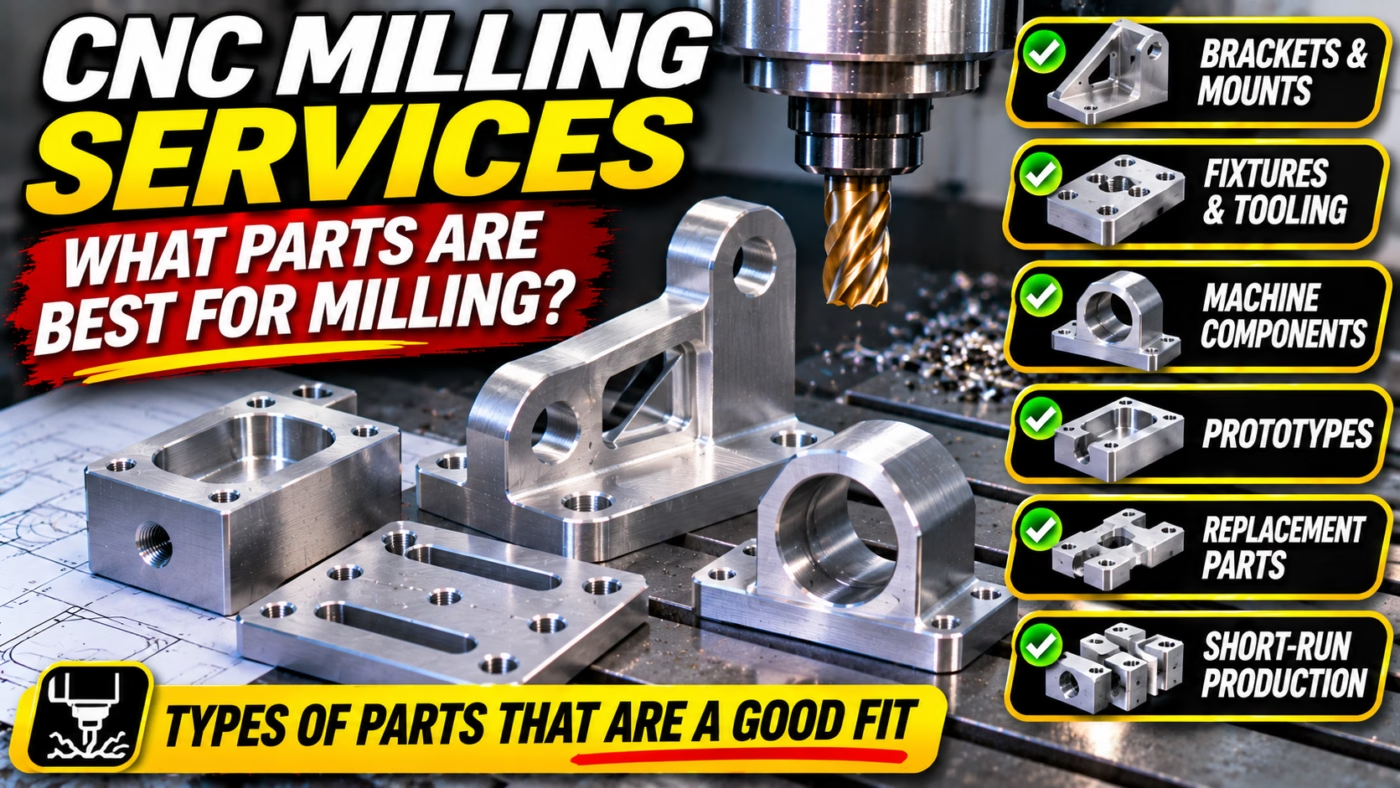
CNC Milling Services: What Parts Are Best for CNC Milling?
Nov
CNC Milling Services: What Parts Are Best Suited for CNC Milling?
When someone needs a custom metal part made, “CNC machining” is usually the first term they hear.
But CNC machining covers several different processes.
One of the most common is CNC milling.
Milling is extremely versatile, but it is not automatically the best process for every part. Understanding what CNC milling does well—and where another manufacturing method may make more sense—can save a lot of time and money before a job ever reaches the machine.
If you are looking for CNC milling services, here are the types of parts and features that are generally a good fit.
What Is CNC Milling?
A CNC milling machine uses rotating cutting tools to remove material from a workpiece.
The part is held securely while the machine moves the cutter relative to the material.
Depending on the machine and setup, milling can produce features such as:
- Pockets
- Slots
- Holes
- Counterbores
- Flat surfaces
- Contoured surfaces
- Threads
- Bores
- Chamfers
- Complex profiles
The process can be used on aluminum, steel, stainless steel, plastics, and many other materials.
What makes milling useful is its ability to create several different features on the same component with good repeatability.
CNC Milling Is Excellent for Prismatic Parts
One of the best applications for CNC milling is what machinists often call a prismatic part.
That basically means a component built around flat surfaces, holes, pockets, slots, and machined profiles.
Examples include:
- Mounting brackets
- Fixture plates
- Machine components
- Adapter blocks
- Bearing housings
- Vise jaws
- Tooling
- Equipment replacement parts
These parts can often be made efficiently because many features are accessible from a small number of directions.
The easier the cutter can reach the required geometry, the more straightforward the machining process becomes.
Flat Parts With Precision Features Are a Good Fit
Some parts begin as relatively simple plate or bar stock but need accurate machined features.
Maybe the outside shape is simple, but the component requires:
- Precision hole locations
- A bearing pocket
- A machined reference surface
- Threaded holes
- A locating shoulder
That is a good application for milling.
A part does not need to look complicated to benefit from CNC machining.
Sometimes the entire reason for milling is simply to establish accurate relationships between a few important features.
Milling Works Well for Custom Machine Components
This is one area where CNC milling really earns its keep.
Machine builders constantly need components that do not exist in a catalog.
You may need:
- A custom spacer
- An equipment adapter
- A shaft support
- A mounting block
- A fixture component
- A replacement bracket
- A locating plate
Off-the-shelf components are great when they work.
When they do not, a custom machined part can solve the problem cleanly instead of building an assembly around something that was never designed for the application.
That same approach is used throughout Beck Tools products.
The BA Shredder 2×72 Belt Grinder uses custom components where alignment, rigidity, and mechanical function matter.
Our CNC Plasma Machine Torch Holder is another example of machining being used to create geometry that directly affects how the product functions.
Prototypes Are Often Good Milling Jobs
CNC milling is particularly useful for prototypes because you do not necessarily need dedicated production tooling.
A CAD model can be programmed and machined directly from standard stock.
That makes it possible to produce a functional metal prototype without investing in molds, dies, or other specialized tooling.
This is especially valuable when you are still proving a design.
If something needs to change, the CAD model can be updated and another part machined.
For low quantities, that flexibility can outweigh the higher cost per piece compared with a dedicated mass-production process.
Short Production Runs Can Make Sense Too
People sometimes assume CNC machining is only practical for one-off parts.
That is not true.
Once a CNC milling job is programmed, fixtured, and proven, producing additional parts becomes much more efficient.
This is why short-run production can be a good fit.
The first part carries much of the programming and setup work.
Those costs are then distributed over the rest of the batch.
If you know you are going to need ten parts instead of one, quoting them together can often reduce the cost per piece substantially.
Beck Tools offers CNC machining services for custom parts, prototypes, replacement components, and short production runs.
Milling Is Not Always the Best Choice
One misconception about CNC machining is that if a machine can physically make something, milling must be the right way to make it.
That is not always true.
A part made from thin sheet metal might be better suited for:
- Laser cutting
- Plasma cutting
- Waterjet cutting
- Forming
A simple round shaft may be better suited for a lathe.
A high-volume plastic component may eventually make more sense as a molded part.
Manufacturing should be chosen around the part, quantity, tolerance, material, and cost—not around forcing everything through one machine.
Deep Cavities Can Become Expensive
Deep pockets are one of those features that look easy on a computer screen.
The difficulty is tool reach.
As the pocket gets deeper, the cutter generally needs to extend farther from the tool holder.
That makes the tool less rigid.
Less rigidity can mean:
- Chatter
- Slower feeds
- Smaller depths of cut
- Tool deflection
- Longer machining times
If you are designing a milled component, avoiding unnecessarily deep, narrow cavities can make the part much easier to manufacture.
Sharp Internal Corners Are a Common Design Problem
A milling cutter is round.
That means it cannot machine a perfectly sharp inside corner.
The inside radius of the part must be at least as large as the cutting tool used to create it.
If you specify an extremely small corner radius, the machinist may have to use a much smaller cutter than would otherwise be necessary.
That usually means slower material removal and a less rigid tool.
If the corner does not need to be tiny for functional reasons, increasing the radius can reduce machining time.
This is one of the simplest design changes you can make to reduce CNC milling cost.
Features on Every Side Mean More Setups
Another thing to consider is how many sides of the part need machining.
If all of the important features are accessible from the top, the job may be relatively simple.
If features exist on the top, bottom, front, back, and sides, the part may need to be repositioned several times.
Every additional setup requires time to:
- Re-clamp the component
- Locate it accurately
- Establish work coordinates
- Verify alignment
Sometimes those setups are unavoidable.
But if a design can be changed so several features are machined from the same direction, it can reduce manufacturing time without changing the function of the part.
Tolerances Still Need to Match the Function
CNC milling can produce very accurate parts.
That does not mean every dimension should receive an extremely tight tolerance.
A bearing bore may legitimately need precise control.
The outside edge of a mounting plate may not.
Unnecessarily tight tolerances can add finishing passes, inspection, adjustment, and scrap risk.
The goal should be accurate enough for the part to function correctly—not tighter simply because the machine is capable of it.
When CNC Milling Is a Good Choice
CNC milling is worth considering when your part needs:
- Accurate hole locations
- Flat machined surfaces
- Pockets or slots
- Custom profiles
- Threaded features
- Bearing or locating features
- Repeatability between multiple parts
- A functional prototype
- Low- or medium-quantity production
It becomes particularly useful when several of those features need to exist accurately in relation to one another.
The Bottom Line
CNC milling is one of the most versatile ways to manufacture custom parts.
It works particularly well for brackets, fixtures, machine components, prototypes, replacement parts, housings, plates, and other components built around machined surfaces and features.
But a good machine shop should not try to convince you that everything needs to be CNC milled.
The best manufacturing process is the one that produces the required part efficiently and accurately.
If you have a custom component, prototype, replacement part, or short production run you need manufactured, visit our CNC Machining Services page to request a quote.
