
 Beck’s Toolbox
 Knives
 DIY Build Kits
 Digital Downloads
 Machine Accessories
 Fabricating Materials
CNC Machining
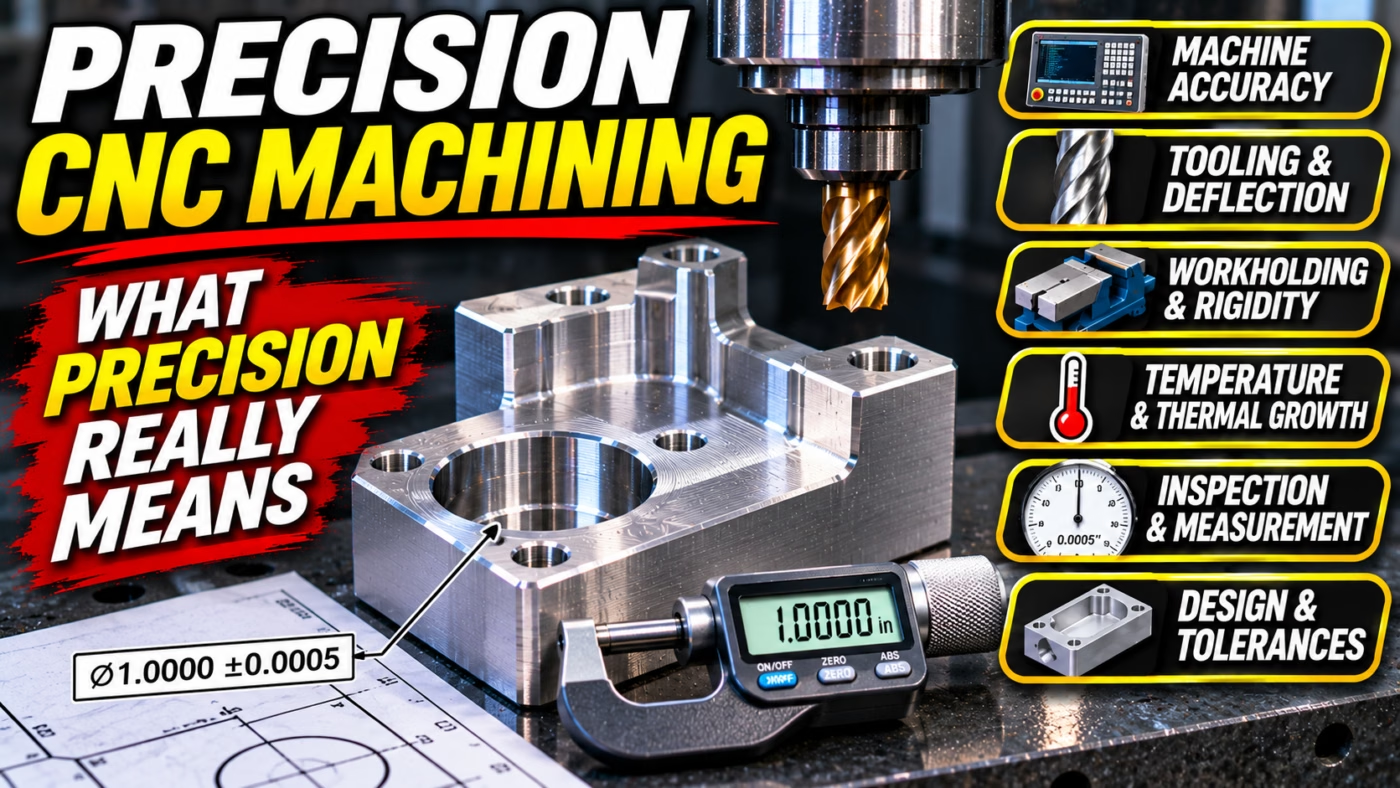
Precision CNC Machining: What Precision Really Means
Nov
Precision CNC Machining: What Precision Really Means
“Precision CNC machining” gets used so often in advertising that the word precision can start to lose its meaning.
A CNC machine can move in extremely small increments, but that does not mean every part automatically comes off the machine accurate to a few ten-thousandths of an inch.
Real precision machining is about controlling the entire manufacturing process—not just owning a CNC machine.
That includes the machine, cutting tools, workholding, temperature, inspection, programming, material, and the design of the part itself.
CNC Accuracy and CNC Resolution Are Not the Same Thing
One common misconception is assuming that because a CNC machine can command an axis movement of 0.0001 inch, it can automatically produce every feature within 0.0001 inch.
Those are two very different things.
The control may be capable of commanding extremely small movements, but the finished part is affected by much more than commanded position.
Real machining involves:
- Machine geometry
- Ball screw and servo behavior
- Spindle condition
- Tool runout
- Cutter deflection
- Tool wear
- Workholding
- Material movement
- Thermal growth
- Measurement uncertainty
That is why a machine specification alone does not tell you what tolerance a shop can reliably hold on every feature.
Precision Depends on the Feature
A statement like “this machine holds ±0.001 inch” is incomplete without knowing what is being measured.
Holding ±0.001 inch on the overall length of a small aluminum block is different from holding it on:
- A deep bore
- A thin wall
- A long pocket
- A hole location across a large plate
- A feature machined in a second setup
The geometry matters.
A short, rigid feature with good tool access is generally easier to control than something requiring a long tool or multiple setups.
Precision machining has to be evaluated feature by feature.
Tool Deflection Can Change the Finished Size
Cutting tools bend.
Usually the movement is small, but when tolerances become tight, small movements matter.
Imagine machining the side of a steel component with a long end mill.
As the cutter engages the material, cutting force can push the tool away from the part.
The CNC machine may be exactly where the program tells it to be, but the cutting edge itself is no longer in the theoretical position.
That can leave the part oversized or tapered.
The machinist may compensate by:
- Reducing tool engagement
- Taking a dedicated finish pass
- Using a shorter tool
- Using a larger-diameter cutter
- Adjusting feeds and speeds
- Compensating for measured tool behavior
That is process control.
Workholding Can Affect Accuracy
The vise or fixture holding the part can also change the finished geometry.
Thin parts are especially susceptible.
Clamp something too aggressively and it may distort while being machined.
The
