
 Beck’s Toolbox
 Knives
 DIY Build Kits
 Digital Downloads
 Machine Accessories
 Fabricating Materials
CNC Machining
CNC Machining Services: How to Get an Accurate Quote
Nov
CNC Machining Services: What to Send for an Accurate Quote
If you are requesting a quote from a CNC machine shop, the quality of the information you provide can have a surprisingly large effect on the quote you receive.
A machinist can usually tell that you need a rectangular aluminum part with a few holes.
What they cannot always tell from a picture is:
- Which dimensions are critical
- What material you actually need
- How many parts you want
- Whether appearance matters
- Whether a hole is clearance or a precision fit
- Whether the part needs secondary operations
- Whether you need one part or fifty
The more uncertainty a shop has to account for, the harder it is to quote the job accurately.
If you are looking for CNC machining services, here is what I recommend sending with your request.
Start With a 3D Model
If you have a CAD model, send it.
STEP is one of the most useful formats because it transfers solid geometry between most modern CAD and CAM systems without tying the file to one specific software package.
A good 3D model allows the machinist to evaluate:
- Overall geometry
- Pocket depths
- Hole locations
- Tool access
- Internal radii
- Number of setups
- Raw material requirements
It also saves time compared with rebuilding geometry from a PDF drawing.
That does not mean the model replaces the drawing.
The two files serve different purposes.
Include a Drawing When Dimensions Actually Matter
A CAD model shows the nominal shape of the part.
It does not necessarily communicate which dimensions are important.
That is where the drawing becomes valuable.
A useful drawing should identify things such as:
- Critical dimensions
- Tolerances
- Hole sizes
- Thread specifications
- Fits
- Surface-finish requirements
- Material
- Datums when required
If a feature simply needs to look like the CAD model and normal machining tolerances are acceptable, it may not need an individual tolerance.
But if a 1.000-inch bore needs to fit a specific shaft or bearing, that should be communicated clearly.
Do not make the shop guess.
Tell the Shop What Material You Want
“Make it out of aluminum” leaves a lot of unanswered questions.
6061 aluminum is very different from 7075.
1018 steel is different from 4140.
304 stainless is different from 17-4.
If material properties matter, specify the actual alloy.
If they do not, say so.
There are situations where I would rather have the customer say:
“Aluminum is fine. Use whatever common machinable grade makes the most sense.”
That gives the shop flexibility.
There is no benefit to specifying an expensive or difficult material unless the design actually requires it.
Always Include Quantity
Quantity has a major effect on CNC machining cost.
A machine shop may spend several hours programming, setting up tools, preparing stock, and proving a job before the first finished part is complete.
If you order one part, that setup belongs to one part.
If you order twenty, the setup gets distributed across the entire batch.
When requesting a quote, specify the quantity you actually expect to need.
If you are unsure, ask for multiple quantities.
For example:
- 1 piece
- 5 pieces
- 25 pieces
That can help you see how dramatically the price per part changes once setup cost is spread across a production run.
Explain What the Part Does
This is something I think customers underestimate.
You do not necessarily need to provide the entire history of the project.
But a little functional context can be extremely helpful.
For example:
“This bore holds a bearing.”
“These two holes locate the assembly with dowel pins.”
“This surface just needs to clear another bracket.”
That information helps identify which dimensions deserve attention.
It can also expose situations where a drawing is unintentionally over-toleranced.
As a machine designer, I would much rather understand why a feature matters than blindly manufacture every dimension as though it were equally critical.
Do Not Assume Every Dimension Needs a Tight Tolerance
One of the fastest ways to increase the cost of a machined part is applying tight tolerances everywhere.
If every dimension is marked ±0.001 inch, the shop has to treat every dimension accordingly.
That may require:
- Additional finish passes
- More inspection
- More frequent offset adjustments
- Better measurement equipment
- More scrap risk
If a dimension only needs to clear another component, give it enough tolerance to do its job.
Precision should be used where it matters.
We covered this in more detail in our article on CNC machining tolerances and why tighter is not always better.
Specify Threads Clearly
Thread callouts should not be ambiguous.
For an inch thread, something like:
1/4-20 UNC-2B
communicates much more than simply writing:
1/4-inch tapped hole
If thread depth matters, specify it.
If the hole can pass completely through the part, that can sometimes simplify machining compared with a blind threaded hole.
Also make it clear whether you need:
- Tapped threads
- Thread-milled threads
- Inserts
- Helicoils
- Pipe threads
Small details prevent questions later.
Tell the Shop About Surface Finish and Appearance
There is a major difference between a functional machine component and a cosmetic product part.
If machining marks are acceptable, say so.
If the part needs a specific surface finish, anodizing, polishing, bead blasting, or another finishing operation, include that in the quote request.
Otherwise, the shop may quote a functional machined finish while you are expecting something cosmetic.
That becomes a problem for everyone.
Photos Help With Replacement Parts
Sometimes there is no CAD model.
There is only a broken part sitting on your bench.
In that situation, send good photographs.
Useful photos include:
- Overall views
- Both sides
- Close-ups of important features
- The part installed in the machine
- A ruler or scale for reference
If the part is being replaced because it failed, explain how it failed.
That may affect material selection or design decisions.
Beck Tools provides CNC machining services for custom components, prototypes, replacement parts, and short production runs, including jobs where the starting point is an existing component rather than a complete CAD package.
Replacement Parts Sometimes Require Reverse Engineering
A worn component presents an additional challenge.
Suppose a shaft measures 0.743 inch.
Was it originally 0.750 inch and has worn down?
Or was it intentionally made 0.743 inch?
That cannot always be determined by measuring the old component alone.
The mating assembly can provide important clues.
This is one reason experience with machine design is useful when reverse engineering parts.
You are not simply copying dimensions.
You are trying to determine the original functional intent.
Think About Manufacturing Before Sending the Quote
A small design change can sometimes dramatically reduce the price.
Before sending the part out, look for:
- Very small internal radii
- Deep narrow pockets
- Features on every side
- Unusual threads
- Excessively tight tolerances
- Odd material thicknesses
- Features requiring very long cutting tools
These things may be necessary.
But if they are not, removing them can make the part easier and less expensive to machine.
The BA Shredder 2×72 Belt Grinder is designed around this same philosophy: machine the features that matter mechanically without adding complexity where it provides no benefit.
Our CNC Plasma Machine Torch Holder follows the same approach. The machined geometry supporting and locating the torch serves a specific mechanical purpose rather than simply making the component more complicated.
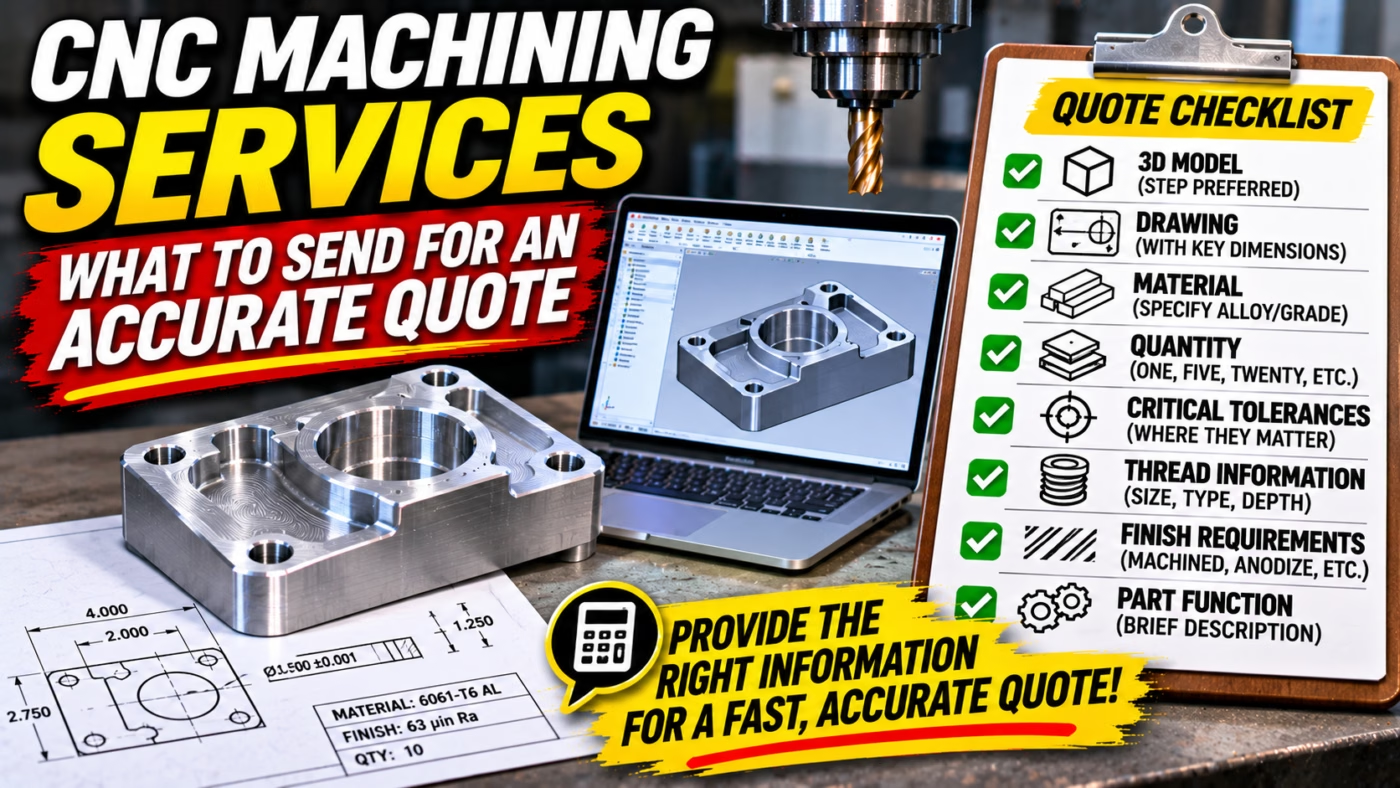
What I Would Send for a CNC Machining Quote
For a typical custom part, the ideal quote package is fairly simple:
- STEP model
- PDF drawing
- Material specification
- Quantity
- Critical tolerances
- Thread information
- Finish requirements
- Brief explanation of the part’s function
If you do not have all of those things, that does not necessarily mean the part cannot be quoted.
Send what you have.
Just understand that missing information may require questions before an accurate price can be established.
The Bottom Line
Getting a good CNC machining quote is not about creating the most complicated drawing possible.
It is about clearly communicating what the part needs to do.
Give the machine shop enough information to understand the geometry, material, quantity, critical features, and functional requirements.
That reduces uncertainty and makes it easier to quote the manufacturing process accurately.
And if a dimension, material, or finish does not actually matter, saying that can be just as useful as specifying something that does.
If you have a custom part, prototype, replacement component, or short production run you need manufactured, visit our CNC Machining Services page and send us your project information.
