
 Beck’s Toolbox
 Knives
 DIY Build Kits
 Digital Downloads
 Machine Accessories
 Fabricating Materials
CNC Machining
Custom CNC Machining vs Fabrication: Which Is Better?
Nov
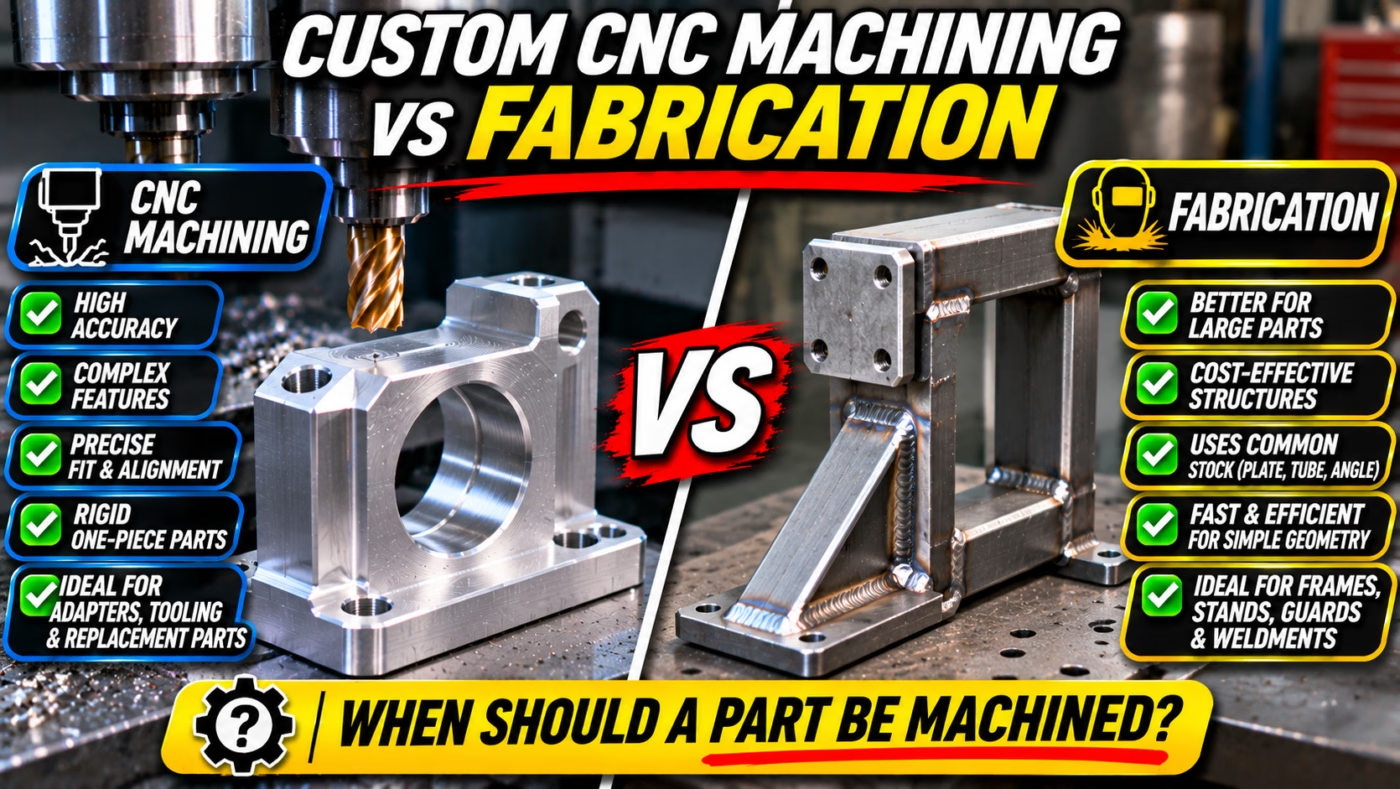
Custom CNC Machining vs Fabrication: When Should a Part Be Machined?
A common mistake in machine design is assuming that a part should be CNC machined simply because machining can produce it.
The opposite mistake happens too.
Sometimes a fabricated part gets designed from several plates, spacers, welds, and fasteners when one machined component would be simpler, stronger, and more accurate.
There is no universal winner.
The right choice depends on geometry, quantity, tolerance, material, load, and what the part actually needs to do.
When I am deciding between fabrication and custom CNC machining, these are the things I look at first.
Fabrication Is Usually Better for Large, Simple Structures
If I need a large frame, stand, table, guard, or bracket, machining the entire thing from a solid block would usually make no sense.
Fabrication works well when the part is mostly made from:
- Plate
- Tubing
- Angle
- Channel
- Sheet metal
- Welded structural members
You can often create a large, rigid assembly with relatively little material waste.
Trying to machine the same structure from a large billet could mean buying an expensive block of material and turning most of it into chips.
That is usually a bad trade.
CNC Machining Makes Sense When Features Need to Relate Accurately
Machining becomes much more attractive when several features need to be precisely related to one another.
For example, imagine a bearing block with:
- A precision bore
- Two mounting holes
- A locating shoulder
- A reference surface
Those features all need to exist in the correct relationship.
Machining them into one component can make that relationship much easier to control than welding several pieces together and trying to hold everything accurately afterward.
This is one of the biggest advantages of custom CNC machining.
The part can be produced from a common reference system rather than assembled from several components that each introduce variation.
Welding Can Move Things
Welding is extremely useful, but it introduces heat.
Heat causes material to expand, contract, and distort.
That is not a problem for every component.
A welded machine frame can work perfectly even if it moves slightly during fabrication.
But if the weldment also contains precision bearing locations or alignment surfaces, distortion can become a major problem.
In those cases, a common approach is to fabricate the structure first and then machine the critical features afterward.
That gives you the economy of fabrication with precision where it matters.
Machining Can Eliminate Entire Assemblies
Sometimes a machined part looks more expensive until you count everything required to build the fabricated alternative.
Suppose a fabricated assembly requires:
- Three plates
- Two spacers
- Eight fasteners
- Welding
- Grinding
- Assembly
- Alignment
A single machined component might replace all of it.
Now the comparison is not simply:
Machined part vs. piece of plate
It is:
Machined part vs. complete fabricated assembly
The machined component may also eliminate loose hardware, alignment problems, and assembly labor.
One-Piece Parts Can Be More Rigid
Every bolted or welded interface changes how a structure behaves.
Sometimes that does not matter.
Sometimes it matters a lot.
A machined component made from one solid piece can provide excellent rigidity because the load passes through continuous material rather than across several joints.
That can be useful for:
- Bearing supports
- Tooling
- Machine brackets
- Spindle mounts
- Fixtures
- Alignment components
But one-piece construction is not automatically better.
If the part becomes extremely large or requires removing huge amounts of material, a fabricated design may still be the smarter solution.
CNC Machining Is Useful for Complex Interfaces
One of the strongest applications for machining is creating a part that connects two things that were never designed to fit together.
Examples include:
- Motor adapters
- Bearing adapters
- Equipment mounting plates
- Retrofit brackets
- Sensor mounts
- Machine-tool adapters
These parts often require several accurate hole patterns, bores, pockets, or locating features.
That is exactly where CNC milling performs well.
If you need a custom adapter or machine component, Beck Tools offers CNC machining services for prototypes, replacement parts, and short production runs.
Fabrication Can Be Better When Material Removal Is Extreme
Imagine starting with a 6 × 6 × 6-inch block of aluminum and machining a part that eventually weighs one pound.
Technically, that may be completely possible.
But most of your expensive material becomes chips.
That also means more machine time.
In a situation like that, I would ask whether the part could instead be:
- Fabricated
- Built from several machined components
- Started from a near-net-shape blank
- Redesigned around more practical stock
Removing material is not free.
The fact that a CNC machine can remove it does not mean it should.
Quantity Changes the Answer
A one-off component and a thousand-piece production run are different manufacturing problems.
For low quantities, custom CNC machining can be very attractive because it generally does not require expensive dedicated tooling.
You can create a model, program the part, build a reasonable setup, and produce it directly.
At higher quantities, another process may become more economical.
That could include:
- Casting
- Forging
- Stamping
- Extrusion
- Dedicated production fixtures
The best process can change as quantity increases.
Machining Is Excellent for Replacement Parts
Replacement machine parts are one of my favorite examples of when machining makes sense.
Older equipment often contains components that are:
- Obsolete
- No longer supported
- Extremely expensive from the OEM
- Modified from the original design
- Unavailable individually
A worn or broken component can often be measured, modeled, and reproduced.
Sometimes the replacement can also be improved.
Maybe the original material was inadequate.
Maybe a weak area can be strengthened.
Maybe a difficult-to-replace assembly can be redesigned into something easier to service.
That is where machining and machine-design experience work well together.
Sometimes the Best Answer Is Both
Machining and fabrication are not competing processes.
They work extremely well together.
A good machine assembly may include:
- A welded frame
- Laser-cut plates
- Turned shafts
- CNC-machined bearing blocks
- Standard purchased hardware
Each process is doing the job it handles best.
That is usually a better approach than forcing one manufacturing method onto every component.
Real Products Often Use Multiple Processes
The BA Shredder 2×72 Belt Grinder is a good example of designing around function rather than one manufacturing process.
Some components benefit from machining because alignment and fit matter.
Other structural components are better suited to fabrication.
Our CNC Plasma Machine Torch Holder is different.
The full-radius clamping geometry is exactly the kind of feature that benefits from machining because the geometry directly controls how the torch is supported.
The manufacturing method should follow the function.
How I Decide Whether to Machine or Fabricate a Part
When I look at a new design, I ask:
- How large is the part?
- How much material would machining remove?
- Which features actually require precision?
- Would welding create alignment problems?
- Could one machined component replace several fabricated pieces?
- How many parts are needed?
- Does the part need to be rigid?
- Would a combination of machining and fabrication work better?
Those questions usually make the correct manufacturing direction fairly obvious.
The Bottom Line
Custom CNC machining is extremely useful, but it should not be the default answer for every component.
Fabrication is usually more efficient for large, simple structures.
Machining becomes especially valuable when you need accurate feature relationships, complex interfaces, precision fits, rigid one-piece components, or replacement parts that cannot be purchased.
The best design is usually the one that lets each manufacturing process do what it does best.
If you have a custom machine component, prototype, adapter, replacement part, or short production run you need manufactured, visit our CNC Machining Services page to request a quote.
