
 Beck’s Toolbox
 Knives
 DIY Build Kits
 Digital Downloads
 Machine Accessories
 Fabricating Materials
CNC Machining
Prototype CNC Machining: Why CNC Works for Low-Volume Parts
Nov
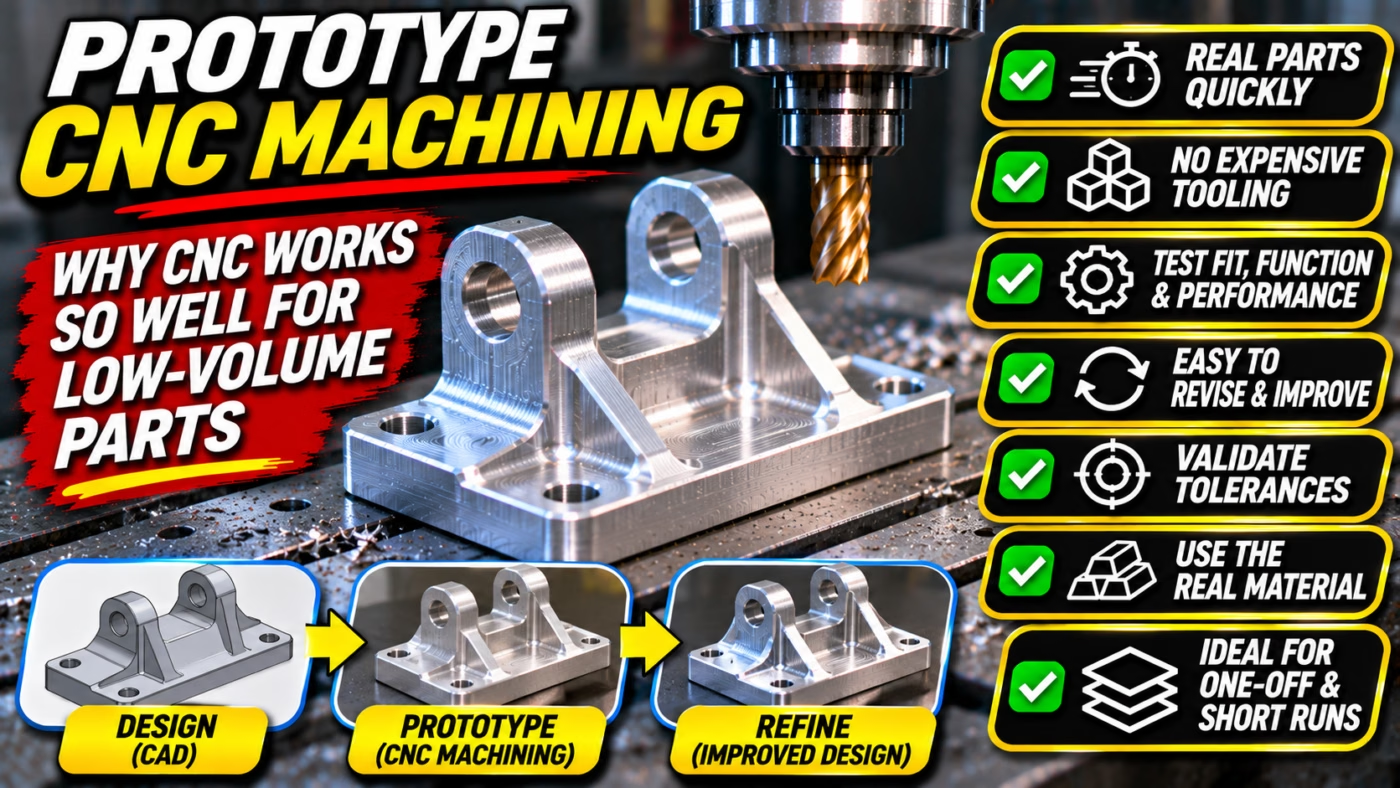
Prototype CNC Machining: Why CNC Works So Well for Low-Volume Parts
One of the biggest advantages of CNC machining is that you do not need to build expensive dedicated tooling before making the first part.
That makes prototype CNC machining especially useful when you need one part, a handful of parts, or a design that is still changing.
You can go from a CAD model to a real aluminum, steel, stainless, or plastic component relatively quickly, test it in the actual application, make changes, and machine another version.
For product development and machine design, that flexibility can be more valuable than getting the absolute lowest possible cost per part.
CNC Machining Is Well Suited to Real Functional Prototypes
There is an important difference between a visual prototype and a functional prototype.
A visual prototype may only need to show:
- Shape
- Size
- General appearance
- Assembly arrangement
A functional prototype actually needs to behave like the finished component.
That may mean it needs:
- Real threads
- Bearing fits
- Accurate hole locations
- Structural strength
- Proper stiffness
- Wear resistance
- A realistic surface finish
This is where CNC machining becomes extremely useful.
Instead of testing a plastic representation of a steel machine component, you can test the actual geometry in the actual material.
You Do Not Need Production Tooling
Many manufacturing processes become economical only after investing in tooling.
Depending on the process, that could mean:
- Molds
- Dies
- Stamping tools
- Casting patterns
- Dedicated fixtures
That investment may make perfect sense when producing thousands of parts.
It usually does not make sense when you need three.
With CNC machining, the main upfront work is generally:
- Programming
- Tool selection
- Workholding
- Setup
Once those are complete, the part can be machined directly from standard stock.
That makes CNC an excellent bridge between design and production.
A Prototype Lets You Find Problems Before Production
CAD is extremely powerful.
But CAD cannot tell you everything.
A part can look perfect on the screen and still create problems when it reaches the real machine.
You may discover:
- A wrench cannot reach a bolt
- A cable interferes with the bracket
- A bearing is difficult to install
- A mounting hole needs more clearance
- A wall is unnecessarily thick
- A feature is harder to machine than expected
- Two components interfere during motion
Finding those problems on prototype number one is much cheaper than finding them after producing one hundred parts.
Prototype Machining Helps Validate Tolerances
Prototyping is also a good opportunity to determine which tolerances actually matter.
A designer may initially think a dimension needs to be held within ±0.001 inch.
After assembling the prototype, you may discover that ±0.005 inch works perfectly.
Or you may discover that another feature needs tighter control than originally expected.
This is one reason I prefer using prototypes as engineering tools rather than treating them as miniature production runs.
The prototype should teach you something.
The First Part Is Usually the Most Expensive
This surprises people sometimes.
If one prototype costs $300, that does not mean ten parts will automatically cost $3,000.
The first part carries much of the upfront manufacturing work.
The shop still has to:
- Review the model
- Program the part
- Prepare stock
- Set up the machine
- Load tools
- Establish offsets
- Prove the program
- Inspect the first piece
Once the process works, additional parts can often be produced much more efficiently.
That is why it can be useful to request pricing at several quantities even during development.
For example:
- 1 part
- 5 parts
- 10 parts
That gives you a much better understanding of how the design scales.
Design Changes Are Relatively Easy
Imagine you machine the first prototype and realize a mounting slot needs to move 0.100 inch.
With CNC machining, that may simply mean updating the CAD model and toolpath.
Compare that with discovering the same problem after building an expensive dedicated die or mold.
That ability to revise quickly is one of CNC machining’s strongest advantages for product development.
Prototype Does Not Mean Sloppy
A prototype does not automatically mean loose tolerances or rough workmanship.
Sometimes the entire reason for building the prototype is to test precision features.
Maybe you need to validate:
- A bearing fit
- A shaft location
- A sliding component
- A locating pin
- A sealing surface
Those features should be machined appropriately.
But there is usually no reason to apply production-level cosmetic requirements to every surface if the prototype is only being used to validate function.
Spend the machining effort where it helps answer the engineering question.
Use the Real Material When Material Properties Matter
A plastic prototype can be extremely useful for checking shape and fit.
It is much less useful if the real question is whether the part will survive a mechanical load.
If stiffness, strength, temperature, wear, or thread durability matter, machining the prototype from the intended production material gives you much more useful information.
For example, a bracket machined from 6061 aluminum behaves very differently from the same geometry printed from plastic.
Both prototypes can be valuable.
They simply answer different questions.
Prototype Parts Should Still Be Designed for Manufacturing
There is a temptation to think:
“It is only one prototype, so manufacturability does not matter.”
It still matters.
The machinist still needs to reach the features.
The part still needs to be held.
A deep narrow pocket is still difficult to machine.
A tiny internal radius still requires a small cutting tool.
Designing the prototype intelligently usually makes the prototype cheaper and also improves the eventual production design.
Prototype Machining and Product Development Go Together
A lot of the products we build at Beck Tools went through the same basic process.
Design something.
Build it.
Use it.
Find out what works.
Change what does not.
Build another version.
The BA Shredder 2×72 Belt Grinder is made up of components that have to work together mechanically, not just look correct in CAD.
Our Belt Grinder Wheel Kit is another example where machined geometry, bearing locations, and alignment directly affect how the finished product performs.
Physical parts expose things that are easy to overlook on a computer screen.
When Should You Use CNC for a Prototype?
CNC machining is particularly useful when your prototype needs:
- Real material properties
- Accurate geometry
- Threads
- Bearing fits
- Precision holes
- Flat surfaces
- Functional strength
- Production-like dimensions
It is also useful when you expect to need several prototype revisions without investing in dedicated tooling.
When Might Another Prototype Method Be Better?
CNC machining is not automatically the best answer for every prototype.
3D printing may make more sense when:
- You only need to check shape
- The geometry is extremely complex
- The material does not matter yet
- You want a very fast visual model
Fabrication may be better for large structural prototypes.
Laser or plasma cutting may be better for flat sheet components.
The best prototype process depends on what you are trying to learn.
What Should You Send for a Prototype CNC Quote?
If possible, provide:
- A STEP model
- A drawing showing critical dimensions
- Material
- Quantity
- Important tolerances
- Threads
- A short explanation of what the prototype is testing
That last item can be especially useful.
If I know a feature is only there for clearance, I may approach it differently than a feature that controls bearing alignment.
The more clearly the function is communicated, the easier it is to manufacture the prototype intelligently.
The Bottom Line
Prototype CNC machining is valuable because it lets you test a real part before committing to production.
You can validate:
- Geometry
- Fit
- Material
- Strength
- Tolerances
- Assembly
- Manufacturability
And if something is wrong, you can change the design and try again.
That feedback loop is one of the best tools a designer has.
If you need a functional prototype, custom machine component, replacement part, or short production run, visit our CNC Machining Services page to request a quote.
