
 Beck’s Toolbox
 Knives
 DIY Build Kits
 Digital Downloads
 Machine Accessories
 Fabricating Materials
CNC Machining
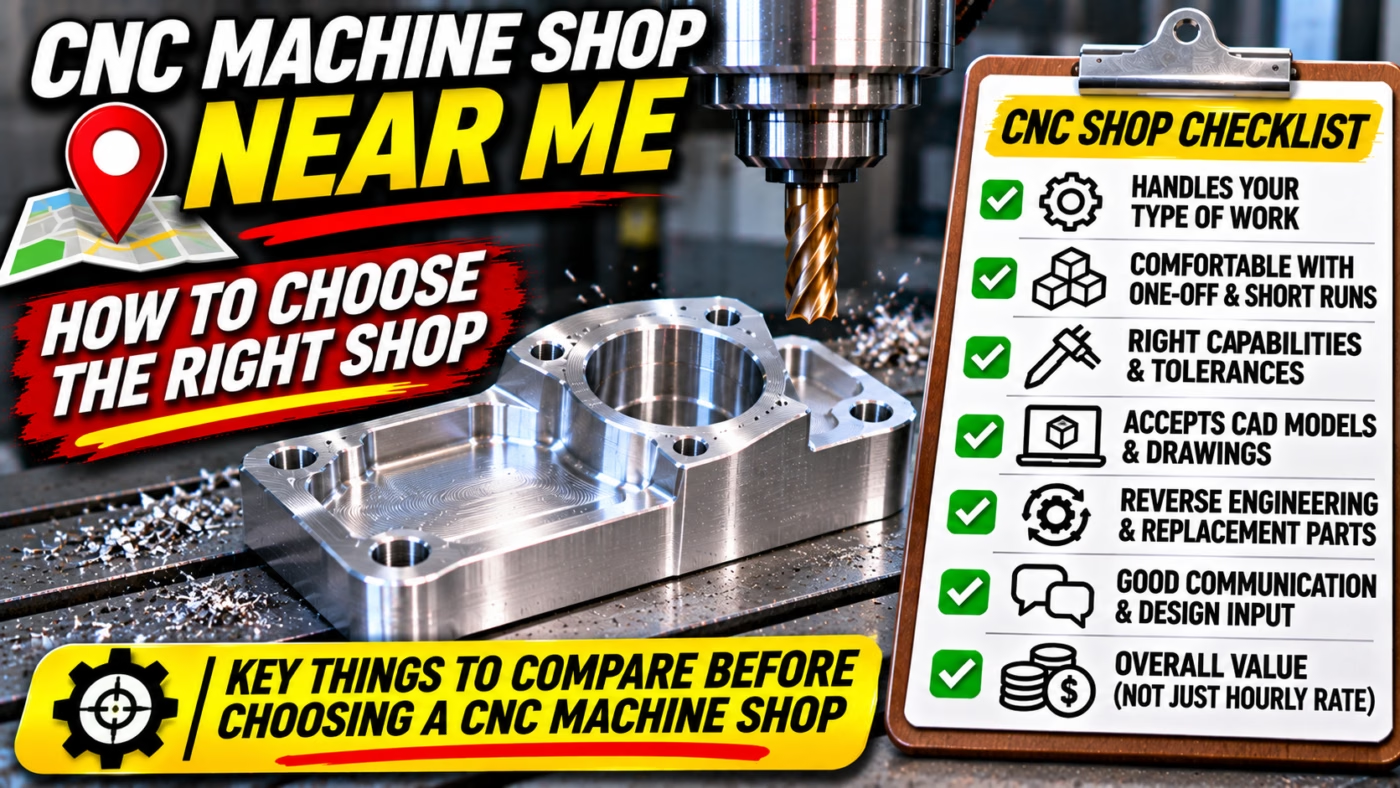
CNC Machine Shop Near Me: How to Choose the Right Shop
Nov
CNC Machine Shop Near Me: How to Choose the Right Shop
When someone searches “CNC machine shop near me,” the temptation is to call whichever shop appears closest on the map.
Distance matters, but it should not be the only thing you consider.
The right CNC shop needs to be a good fit for the type of work you actually need done.
A shop built around thousands of identical production parts may not be interested in your one-off machine component. A prototype shop may be excellent at complicated one-piece jobs but expensive for a hundred simple parts.
Before sending out your next project, here are the things I would look at.
The Closest CNC Shop Is Not Automatically the Best Shop
There are real advantages to working with a local machine shop.
You can potentially:
- Drop off an existing part
- Discuss the project in person
- Look at mating components
- Avoid shipping heavy parts
- Make design changes quickly
- Pick up finished components
That can be extremely valuable for repair work, prototypes, and replacement machine parts.
But being five miles closer does not help if the shop is not equipped or interested in your type of project.
Look for capability first and distance second.
Make Sure the Shop Handles Your Type of Work
“CNC machining” covers a very wide range of manufacturing.
One shop may specialize in large production runs.
Another may focus on aerospace components.
Another may primarily run CNC lathes.
Another may concentrate on milling prototypes and short-run machine parts.
Before requesting a quote, determine whether the shop regularly works on jobs similar to yours.
At Beck Tools, our CNC machining services are focused on custom machined parts, prototypes, replacement components, and short-run work.
That is very different from a production shop designed around making tens of thousands of the same component.
Look at the Parts the Shop Actually Makes
Marketing language only tells you so much.
Nearly every machine shop website uses words like:
Precision. Quality. Experience.
I would rather see actual parts.
Look for examples showing:
- Pockets
- Bores
- Threaded features
- Contours
- Multiple setups
- Finished surfaces
- Real production components
Products manufactured by the shop can also tell you quite a bit.
For example, the Beck Tools Belt Grinder Wheel Kit uses fully CNC-machined 6061 aluminum wheels where geometry, alignment, balance, and bearing locations all matter.
The BA Shredder 2×72 Belt Grinder also contains components we manufacture around actual mechanical requirements rather than simply producing generic demonstration parts.
Real products are a good test of whether machining experience extends beyond making something look good in a photograph.
Ask Whether They Handle One-Off Parts
This is important.
Some machine shops simply do not want one-piece jobs.
There is nothing wrong with that.
Their equipment, quoting system, and business model may be built around production work.
But if you need one replacement bracket for a machine that is currently down, that shop may not be a good fit.
A one-off part requires programming, setup, tooling, and inspection just like a production job.
The difference is that all of that setup cost is being applied to one part.
Look for a shop that is comfortable with prototypes and short-run work if that is what you need.
Replacement Parts Require More Than Machining
Searching for a CNC machine shop near me often happens because something broke.
Maybe you have the old part but no drawing.
That changes the job.
Now someone has to determine:
- What the original dimensions probably were
- Which surfaces are worn
- Which features are critical
- What material should be used
- How the part fits into the machine
That is reverse engineering.
A machinist can copy dimensions, but understanding the mechanical function of the component can be just as important.
For example, a worn shaft measuring 0.743 inch may originally have been 0.750 inch.
Simply copying 0.743 would reproduce the wear rather than the original design.
This is one area where machine-design experience can make a big difference.
Find Out What Information the Shop Needs
A good shop should be able to tell you what it needs to quote your project.
For a normal CNC-machined component, useful information includes:
- STEP model
- Dimensioned drawing
- Material
- Quantity
- Critical tolerances
- Threads
- Finish requirements
- Brief description of what the part does
Do not assume you need all of that before contacting anyone.
For a replacement component, you may only have the physical part and a few photographs.
Send what you have.
The important thing is communicating enough information for the shop to understand the job.
Do Not Choose a Shop Based Only on Hourly Rate
Machine-shop hourly rates are difficult to compare directly.
One machine may remove material much faster than another.
One shop may spend more time building a good fixture but then run the parts considerably faster.
Another may quote fewer hours but require more manual operations.
What matters is the finished price and result, not simply the hourly rate.
The lowest hourly rate does not necessarily produce the lowest-cost part.
Communication Matters
Custom machining involves decisions.
A machinist may discover that:
- A tolerance is unusually tight
- A pocket is difficult to reach
- A thread callout is unclear
- A material is difficult to obtain
- A small design change could dramatically simplify machining
You want a shop willing to ask those questions.
If changing a corner radius from 0.125 inch to 0.250 inch saves significant machining time and has absolutely no effect on the function of the part, I would rather discuss that with the customer than blindly manufacture the more expensive version.
Good communication can save money.
Local Shops Can Be Especially Useful for Machine Repair
One of the biggest advantages of a nearby CNC machine shop is the ability to bring in more than just a drawing.
For repair work, you may be able to bring:
- The broken component
- The mating component
- The bearing
- The shaft
- The assembly
- The hardware
Sometimes seeing how everything fits together answers questions that a drawing never could.
This can make local machining particularly valuable for industrial equipment, custom machinery, and older equipment where documentation may be incomplete or nonexistent.
What About Tolerances?
Ask whether the shop is comfortable with the tolerances your part actually requires.
But do not automatically assume that the shop claiming the tightest tolerance is the best shop.
A good machinist should also be willing to tell you when your tolerance is unnecessarily tight.
There is no benefit to paying for ±0.0005 inch when ±0.005 inch performs exactly the same function.
Precision needs to have a purpose.
Look for a Shop That Understands Manufacturing, Not Just Machining
A CNC mill is a manufacturing tool.
It is not always the correct manufacturing tool.
Sometimes a part should be:
- Fabricated
- Laser cut
- Turned
- Welded
- Made from standard components
- Machined only on critical surfaces
I would rather recommend a simpler manufacturing method than machine a part inefficiently just because I own a CNC mill.
That is usually better for the customer and produces a better design.
CNC Machining in Northeast Indiana and Northwest Ohio
If you are searching for a CNC machine shop in Northeast Indiana or Northwest Ohio, Beck Tools provides custom CNC machining for prototypes, replacement machine components, custom parts, and short production runs.
We can work from a CAD model and drawing, or in some cases start with an existing component that needs to be reproduced.
Visit our CNC Machining Services page to send project information and request a quote.
The Bottom Line
When searching for a CNC machine shop near me, do not choose a shop based on distance alone.
Look for a shop that fits the actual job.
Consider:
- Type of machining
- Quantity
- Part complexity
- Tolerances
- Reverse-engineering ability
- Communication
- Experience with real machine components
A good machining relationship is about more than getting metal cut.
It is about getting the correct part manufactured in a practical way.
