
 Beck’s Toolbox
 Knives
 DIY Build Kits
 Digital Downloads
 Machine Accessories
 Fabricating Materials
CNC Machining
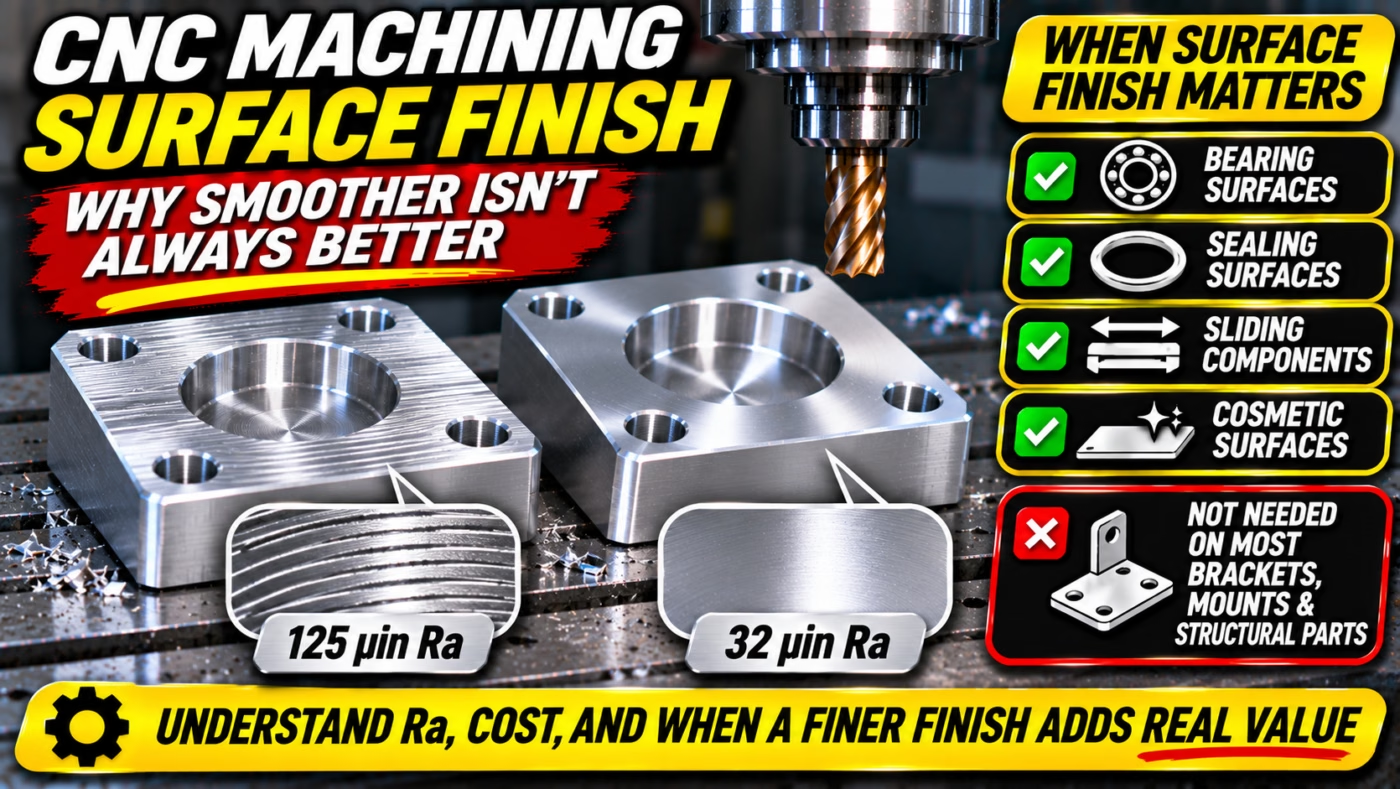
CNC Machining Surface Finish: Why Smoother Isn’t Always Better
Nov
CNC Machining Surface Finish: Why Smoother Isn’t Always Better
Surface finish is another area where CNC machined parts can get more expensive without becoming any better at their actual job.
A drawing might call for a very smooth machined finish because it sounds like higher quality.
But just like tolerances, a smoother surface is only better when the function of the part requires it.
A mounting bracket does not need the same surface finish as a sealing surface, bearing journal, or precision sliding component.
Understanding CNC machining surface finish can help you avoid paying for additional machining that provides no real benefit.
What Does Surface Finish Actually Mean?
A machined surface may look smooth to the naked eye but still contain microscopic peaks and valleys created by the cutting tool.
Surface roughness is commonly expressed as Ra, or roughness average.
Typical drawing callouts might include values such as:
- 250 µin Ra
- 125 µin Ra
- 63 µin Ra
- 32 µin Ra
- 16 µin Ra
As the Ra number decreases, the required surface becomes smoother.
But going from a normal machined finish to a very fine finish is not simply a matter of telling the CNC machine to “make it smoother.”
The manufacturing process may need to change.
A Normal CNC Finish Is Often Perfectly Functional
For many machine components, the surface left by a properly programmed end mill is exactly what the part needs.
Examples include:
- Mounting brackets
- Fixture plates
- Equipment adapters
- Structural machine components
- Clearance surfaces
- Covers
- General-purpose spacers
Visible cutter marks do not automatically mean the part was machined poorly.
A consistent machined surface can be dimensionally accurate and completely functional.
There is no benefit to spending extra machine time polishing a surface that only needs to hold a motor onto a frame.
Why Finer Surface Finishes Cost More
Producing a finer finish may require additional operations.
Instead of roughing the part directly to size, the machinist may leave material for a dedicated finishing pass.
That finishing operation might require:
- A separate cutting tool
- Reduced tool engagement
- Different feeds and speeds
- Additional machine time
- More rigid tooling
- More inspection
- Better control of tool wear
Extremely fine surfaces may require processes beyond normal CNC milling.
Depending on the application, that could include:
- Grinding
- Honing
- Lapping
- Polishing
Every additional operation adds cost.
That cost is completely justified when the surface performs an important function.
It is wasted when the requirement exists only because somebody selected a small Ra number on the drawing.
Toolpath Strategy Affects Surface Finish
The CNC program itself has a large effect on the finished surface.
A roughing operation is designed primarily to remove material efficiently.
A finishing operation has a different goal.
The programmer may change:
- Step-over
- Depth of cut
- Feed rate
- Cutter engagement
- Tool selection
- Toolpath direction
On a contoured surface, reducing the step-over can create a smoother result.
The tradeoff is additional machine time.
Cut the step-over in half and the machine may need roughly twice as many passes across that area.
That can make a cosmetic surface surprisingly expensive.
Cutter Condition Matters
A worn cutting tool can leave a completely different finish than a fresh one.
Tool condition can affect:
- Surface roughness
- Burr formation
- Dimensional accuracy
- Chatter
- Cutting forces
Runout matters too.
If one flute of an end mill is doing considerably more work than the others, the surface can show it.
This is one reason surface finish can sometimes be an early warning that something in the machining process has changed.
Rigidity Matters More Than People Think
You cannot polish your way out of a bad machining setup.
If the cutting tool is hanging several inches out of the holder and vibrating, reducing feed rate may not magically produce a beautiful finish.
Likewise, poor workholding can allow the part itself to vibrate.
Chatter can leave a repeating pattern across the machined surface and can also affect tool life and dimensional accuracy.
The better solution is usually improving rigidity.
That may mean:
- Shortening tool stickout
- Using a larger-diameter cutter
- Improving workholding
- Changing cutting engagement
- Adjusting spindle speed
A stable process produces a better finish much more reliably than simply slowing everything down.
Surface Finish and Tolerance Are Different Requirements
This is important.
A part can be extremely accurate dimensionally and still have visible machining marks.
It can also have a beautiful polished surface and be the wrong size.
Surface finish and dimensional tolerance describe different things.
For example, a bore might require both:
1.0000 ±0.0005 inch
and
32 µin Ra
Those are two separate manufacturing requirements.
One controls size.
The other controls surface texture.
Do not assume specifying one automatically guarantees the other.
When Surface Finish Really Matters
There are plenty of situations where a controlled surface finish is important.
Bearing and Bushing Surfaces
A shaft or bore interacting with a bearing or bushing may require an appropriate finish for proper fit, wear, and lubrication.
Sealing Surfaces
O-rings, gaskets, and mechanical seals can depend heavily on surface condition.
Too rough and the surface may leak or damage the seal.
Sliding Components
Surfaces that move against each other may need controlled roughness to reduce friction and wear.
Cosmetic Components
Sometimes appearance genuinely matters.
A customer-facing aluminum component may need a consistent machined finish before anodizing or another cosmetic treatment.
In those cases, the finish is part of the product.
Cosmetic Machining Is Still Machining Time
This is something worth remembering when ordering custom CNC parts.
Suppose the entire top surface of a component needs a decorative machined pattern.
That might look simple.
But the cutter still has to travel over that entire surface.
A very small step-over might create a beautiful finish while adding significant cycle time.
If appearance matters, that may be worth paying for.
If the part disappears inside a machine enclosure, maybe it is not.
Real Machined Products Show the Difference
You can see this distinction in actual Beck Tools products.
The Belt Grinder Wheel Kit contains CNC-machined aluminum wheels where bearing locations, geometry, and running accuracy matter mechanically.
The machined surfaces exist because the features need to function correctly.
Our CNC Plasma Machine Torch Holder is another example. The full-radius machined clamping surfaces have an actual job: supporting the torch consistently around its circumference.
Those surfaces need to be manufactured correctly.
That does not mean every nonfunctional surface on either product needs a mirror finish.
Do You Need a Surface Finish Callout?
Before adding one to a drawing, ask why the surface needs it.
If the answer is:
“Because this shaft runs in a bearing.”
Good.
If the answer is:
“Because this is a sealing surface.”
Good.
If the answer is:
“I just figured smoother was better.”
It may be worth reconsidering.
A machine shop can usually produce a normal commercial machined finish without requiring every surface to have an individual Ra specification.
Call out special finishes where they actually affect performance.
Surface Finish Should Match the Manufacturing Process
The required finish can also determine which manufacturing process makes sense.
CNC milling may produce the surface you need directly.
A precision shaft might make more sense turned.
A very fine bearing or sealing surface may eventually require grinding.
A precision bore may benefit from boring, reaming, or honing.
The correct manufacturing process depends on what the finished surface actually needs to accomplish.
The Bottom Line
A smoother CNC machined surface is not automatically a better surface.
Surface finish should serve the function of the part.
Normal tool marks may be completely acceptable on a bracket, fixture, or machine component while a bearing, seal, or sliding surface may require considerably more control.
Every additional finishing operation costs time.
Specify the finish you need, but avoid paying for surface quality that provides no functional benefit.
If you need a custom component, prototype, replacement part, or short production run manufactured, visit our CNC Machining Services page to request a quote.
