
 Beck’s Toolbox
 Knives
 DIY Build Kits
 Digital Downloads
 Machine Accessories
 Fabricating Materials
CNC Machining
End Mill Coatings Explained: TiAlN, TiB2, DLC & More
Nov
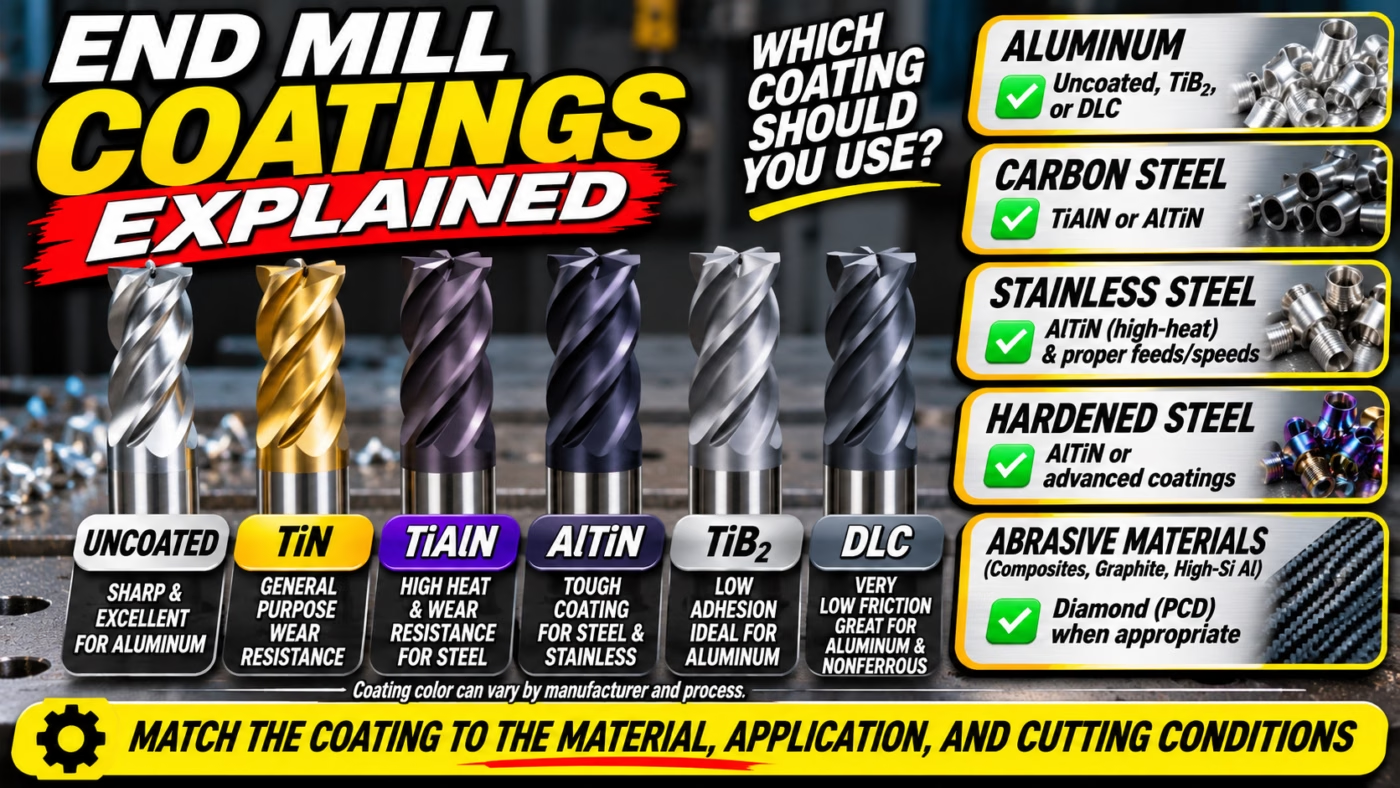
End Mill Coatings Explained: Which Coating Should You Use?
Walk through any cutting-tool catalog and you will find end mills offered with a long list of coatings.
TiN.
TiAlN.
AlTiN.
TiB2.
DLC.
And sometimes the best choice is no coating at all.
It is easy to assume the most expensive or technologically advanced coating must be the best end mill.
That is not how it works.
The best end mill coating depends heavily on the material you are cutting, the amount of heat being generated, whether coolant is being used, and what you need the tool to accomplish.
A coating that performs extremely well in alloy steel may be a poor choice for aluminum.
Here is how I think about the common options.
What Does an End Mill Coating Actually Do?
A coating is a very thin layer applied to the cutting tool.
Depending on the coating, it may help improve:
- Wear resistance
- Heat resistance
- Lubricity
- Tool life
- Resistance to material sticking to the cutter
The important thing is that different coatings accomplish those jobs in different ways.
There is no universal coating that is best for every application.
Uncoated Carbide Is Still Extremely Useful
It is easy to look at an uncoated carbide end mill and assume it is the budget option.
That can be a mistake.
Uncoated carbide can be an excellent choice when you need a very sharp cutting edge, particularly in nonferrous materials.
Aluminum is the classic example.
A sharp polished end mill with good flute geometry can cut aluminum extremely well.
With no coating on the cutting edge, you do not have to accommodate the additional coating thickness or edge preparation that may accompany some coated tools.
For certain applications, simple and sharp is exactly what you want.
TiN: The Classic Gold Coating
Titanium Nitride, or TiN, is probably the coating most people recognize because of its gold color.
TiN has been around for a long time and is used on a wide range of cutting tools.
It can improve wear resistance compared with an uncoated tool and is suitable for many general-purpose applications.
But coating technology has moved well beyond TiN.
For demanding modern milling applications, especially when high temperatures are involved, newer coatings may offer much better performance.
That does not make TiN useless.
It just means you should not automatically select a gold-colored tool because it looks more advanced than an uncoated one.
TiAlN and AlTiN: Excellent Choices for Steel
Titanium Aluminum Nitride and Aluminum Titanium Nitride coatings are commonly used for machining steels and other demanding materials.
You will see the names TiAlN and AlTiN used frequently in cutting-tool catalogs.
The exact coating chemistry and construction vary between manufacturers, but these coatings are generally designed to tolerate significant heat and wear.
That makes them useful when machining materials such as:
- Carbon steel
- Alloy steel
- Stainless steel
- Hardened steels
These coatings can be particularly effective in higher-temperature applications where the cutting process generates substantial heat.
Heat Is Not Always the Enemy
This sounds backwards at first.
When machining steel with the correct coated carbide end mill, you do not necessarily want to eliminate every bit of heat from the cutting zone.
Modern high-temperature coatings are specifically designed to survive conditions that would quickly damage an uncoated tool.
The goal is to control where the heat goes.
Ideally, a large percentage of the heat leaves with the chip rather than accumulating in the cutting tool or workpiece.
This is one reason the correct chip load matters so much.
A cutter that is rubbing instead of cutting can generate tremendous heat without removing material efficiently.
Why Aluminum Is Different
Aluminum creates a different problem.
The challenge is often not simply heat.
It is material adhesion.
Aluminum can stick to the cutting edge of an end mill.
Once material begins welding itself to the cutter, chip evacuation and surface finish can deteriorate rapidly.
Eventually you can get a built-up edge large enough to damage the cutter or ruin the part.
This is why aluminum-specific cutters often focus heavily on:
- Sharp cutting edges
- Polished flutes
- Large chip spaces
- Low-friction surfaces
The best coating for steel is therefore not automatically the best coating for aluminum.
TiB2 Is Commonly Used for Aluminum
Titanium Diboride, or TiB2, is a coating you will frequently see on aluminum-specific end mills.
Its low affinity for aluminum helps reduce the tendency for aluminum to stick to the cutting edge.
That can improve chip evacuation and tool life.
It is particularly useful when machining aluminum and other nonferrous materials.
If I were choosing between a generic coated end mill and a cutter specifically designed for aluminum with the correct geometry and coating, I would generally prefer the aluminum-specific tool.
The flute geometry matters just as much as the coating.
DLC Coatings Are Becoming More Common for Nonferrous Machining
DLC, or Diamond-Like Carbon, coatings are another option for machining aluminum and other nonferrous materials.
DLC coatings provide a very low-friction surface and can help resist material adhesion.
That combination can be particularly useful when machining aluminum at higher speeds.
Tool manufacturers now offer DLC-coated carbide end mills specifically designed around nonferrous materials.
That does not mean every aluminum job suddenly requires DLC.
A good polished uncoated cutter or TiB2-coated tool can still perform extremely well.
DLC simply gives machinists another high-performance option.
Do Not Confuse DLC With Diamond Coating
The names can create confusion.
DLC and true diamond-coated tools are not the same thing.
Diamond coatings are commonly used for highly abrasive nonferrous materials such as:
- Graphite
- Carbon-fiber composites
- Certain high-silicon aluminum alloys
- Other abrasive materials
Diamond can provide exceptional wear resistance.
But diamond tooling is not something I would choose for normal steel machining.
Tool material, coating chemistry, and workpiece material have to be compatible.
Again, there is no universal winner.
Stainless Steel Needs the Right Combination
Stainless can be challenging because many grades tend to work harden and generate significant heat.
The coating matters, but so does everything else.
You need:
- Proper tool geometry
- Adequate rigidity
- Correct chip load
- Appropriate cutting speed
- Good chip evacuation
A premium coating will not save a tool that is rubbing because the feed is too low.
That is an important point.
Coatings improve a good cutting process. They do not replace one.
Coating Cannot Fix the Wrong End Mill Geometry
Suppose you are machining aluminum with a heavily coated, high-flute-count end mill designed for hardened steel.
It may have an excellent coating.
It is still probably the wrong cutter.
Aluminum generally benefits from large flute spaces because the material produces large chips.
A cutter designed for hard steel may have more flutes and considerably less chip space.
Now you have created a chip-evacuation problem before the coating even enters the discussion.
Choose the cutter geometry for the material first.
Then consider the coating.
More Flutes Are Not Automatically Better Either
This connects directly to coating selection.
An aluminum cutter may have two or three flutes to provide lots of room for chips.
A high-performance steel end mill may have four, five, six, or even more flutes.
Neither is automatically better.
The correct flute count depends on:
- Material
- Radial engagement
- Axial depth
- Machine capability
- Tool diameter
- Chip evacuation
You should look at the tool as a complete system rather than choosing based on one feature.
Coolant Strategy Can Affect the Choice
Coolant also matters.
Some cutting situations benefit from flood coolant.
Others work well with mist, air blast, or dry machining.
When machining aluminum, lubrication and chip evacuation can be extremely important because you are trying to prevent chips from sticking to the cutter and being recut.
For steel, certain high-temperature coated carbide applications can perform very well without constantly cooling the tool.
One thing I try to avoid is an inconsistent thermal cycle.
Repeatedly heating a carbide cutter and then suddenly quenching it can be hard on the tool.
Follow the cutting-tool manufacturer’s recommendations for the specific cutter whenever possible.
The Coating Does Not Determine Your Feeds and Speeds by Itself
Another misconception is that buying a premium coated end mill automatically means you can double the feed rate.
Maybe.
Maybe not.
Feeds and speeds still depend on:
- Tool diameter
- Number of flutes
- Workpiece material
- Radial engagement
- Axial depth
- Tool stickout
- Machine rigidity
- Spindle power
- Toolpath strategy
The coating is one part of the equation.
Start with the manufacturer’s recommended cutting data and adjust based on the actual machining conditions.
Tool Life Is Not the Only Goal
Sometimes the longest-lasting end mill is not necessarily the best end mill for the job.
Maybe another cutter produces:
- A better surface finish
- Better chip evacuation
- Lower cutting forces
- Faster cycle time
Tool cost needs to be considered in relation to the complete operation.
If a $60 end mill removes material twice as fast as a $30 tool and lasts just as long, the more expensive tool may actually cost less per part.
The same reasoning applies to CNC machining in general.
Manufacturing cost should be evaluated as a system.
We Use Machining Where the Geometry Matters
The same tooling decisions ultimately affect the components we manufacture at Beck Tools.
Our Belt Grinder Wheel Kit uses CNC-machined aluminum components where bearing locations, geometry, and running accuracy matter.
The BA Shredder 2×72 Belt Grinder also uses machined components where tool selection, workholding, material, and cutting strategy all affect the finished product.
Choosing the right cutting tool is not about buying the fanciest end mill.
It is about reliably producing the part.
A Simple End Mill Coating Starting Point
If you are trying to choose a cutter, this is a reasonable way to start thinking about it:
Aluminum and nonferrous materials: Look at sharp polished tools, uncoated cutters, TiB2, or DLC depending on the application.
General steels: TiAlN, AlTiN, and other modern high-temperature coatings are common choices.
Stainless and difficult alloys: Look for tooling specifically designed for the material, usually with a heat- and wear-resistant coating.
Highly abrasive nonferrous materials: Diamond-coated tooling may make sense.
Then look at the manufacturer’s actual application recommendations.
Do not choose based only on coating color or name.
The Bottom Line
End mill coatings matter.
But the coating is only one part of the cutting tool.
The correct choice depends on:
- Material
- Tool geometry
- Chip evacuation
- Cutting temperature
- Coolant strategy
- Cutting parameters
A premium steel coating may perform poorly in aluminum.
An uncoated polished cutter may outperform a coated cutter in the right application.
The goal is not to buy the end mill with the most impressive coating.
The goal is to select the cutter designed for the material and cutting conditions you actually have.
If you have a custom component, prototype, replacement part, or short production run you need manufactured, visit our CNC Machining Services page to request a quote.
