
 Beck’s Toolbox
 Knives
 DIY Build Kits
 Digital Downloads
 Machine Accessories
 Fabricating Materials
CNC Machining
CNC Machining vs 3D Printing: Which Is Better?
Nov
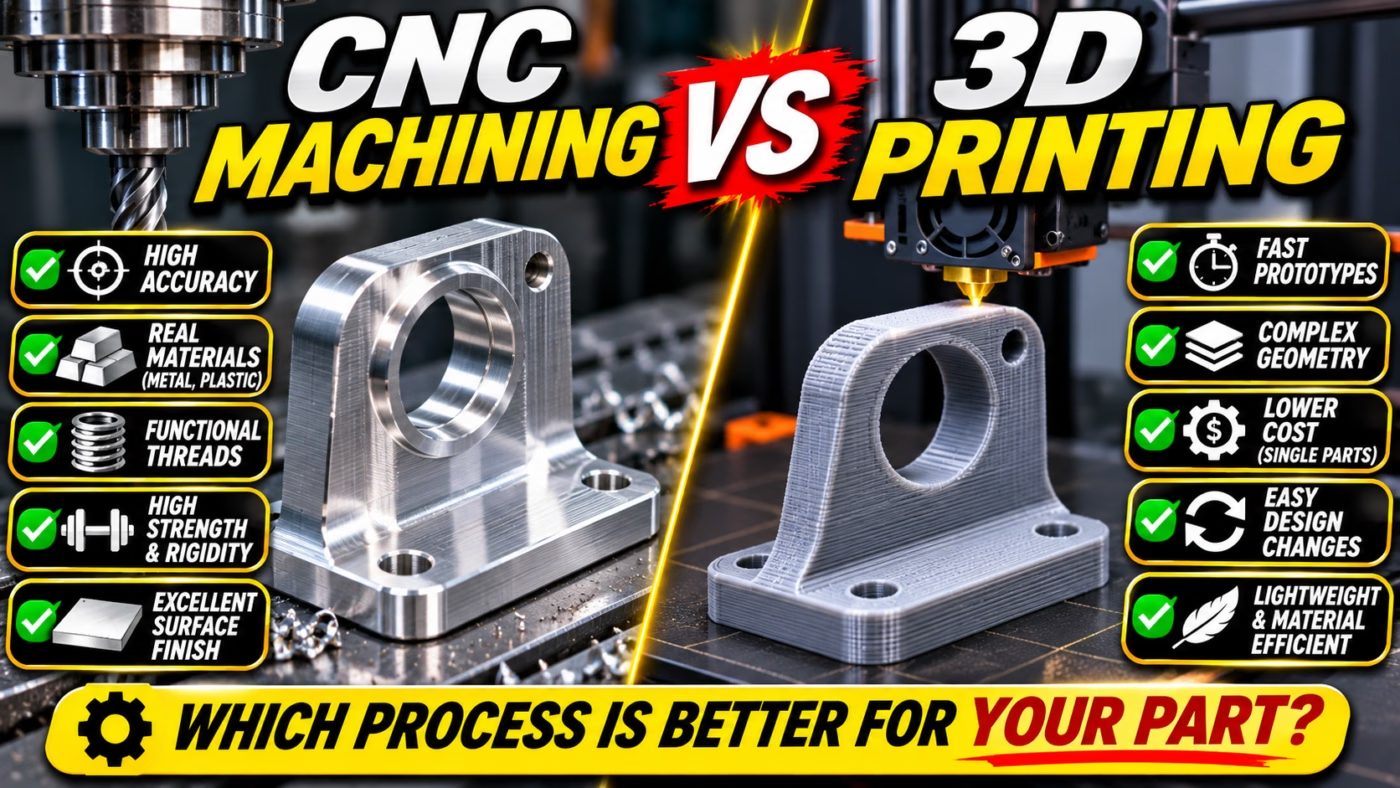
CNC Machining vs 3D Printing: Which Process Is Better for Your Part?
CNC machining and 3D printing are both excellent ways to turn a CAD model into a real part.
They just solve very different problems.
I see people compare them as though one technology is replacing the other, but that misses the point.
A 3D printer can create geometry that would be extremely difficult to machine. A CNC mill can produce accurate metal components with real threads, bearing fits, flat surfaces, and material properties that a printed prototype may never duplicate.
The better question is not:
“Which process is better?”
It is:
“Which process is better for this particular part?”
CNC Machining Removes Material
CNC machining is a subtractive process.
You start with a piece of material and remove everything that does not belong in the finished component.
For CNC milling, that usually means starting with:
- Aluminum plate or bar
- Steel
- Stainless steel
- Engineering plastics
- Other machinable stock
Cutting tools remove material until the finished geometry remains.
This approach produces parts directly from solid material with predictable mechanical properties.
3D Printing Builds the Part
3D printing is an additive process.
Instead of removing material, the machine builds the component layer by layer.
That gives 3D printing a major advantage:
It can create geometry that does not care nearly as much about traditional cutting-tool access.
Internal passages, organic shapes, complex lattices, and other unusual geometry can sometimes be printed easily even though they would be extremely difficult or impossible to produce on a conventional 3-axis CNC mill.
That makes printing incredibly useful.
But geometric freedom does not automatically make it the correct process for every part.
3D Printing Is Excellent for Early Prototypes
If I am developing a new design and mainly need to answer questions like:
- Does this shape fit?
- Are the mounting holes in the right place?
- Does this interfere with another component?
- Can I reach the hardware?
- Is the overall size correct?
3D printing can be hard to beat.
You can make a physical part quickly without machining an expensive block of metal.
If the design changes, update the model and print another one.
For early design verification, that is extremely valuable.
CNC Machining Becomes More Valuable When the Part Has to Work
Things change when the prototype needs to behave like the final component.
Suppose the part includes:
- A bearing bore
- A threaded hole
- A precision locating feature
- A highly loaded mounting surface
- A shaft fit
- A sealing surface
Now the actual material and manufacturing process start becoming more important.
A printed plastic prototype may prove that the geometry fits.
It may tell you very little about whether the final aluminum or steel component will perform correctly.
That is where prototype CNC machining becomes extremely useful.
Real Material Properties Matter
A printed polymer bracket and a machined aluminum bracket may have identical CAD geometry.
They are still completely different components.
Their:
- Strength
- Stiffness
- Wear resistance
- Temperature resistance
- Thread strength
- Surface condition
can be dramatically different.
Even printed metal does not necessarily behave exactly like conventional wrought material.
The manufacturing process affects the final material.
If the purpose of the prototype is to validate structural performance, using the intended production material may be essential.
CNC Machining Is Better for Precision Fits
Imagine a component containing a bearing pocket.
The bearing needs to fit correctly.
That means controlling:
- Bore diameter
- Roundness
- Surface finish
- Position
CNC machining is well suited to these kinds of requirements.
The feature can be machined using boring, interpolation, reaming, or another controlled process depending on the tolerance.
A printed hole may be perfectly adequate for checking whether the bearing is in the right location.
That does not necessarily mean I would trust it for evaluating the final bearing fit.
3D Printing Can Create Geometry CNC Milling Cannot
This is where printing deserves real credit.
A traditional milling cutter has physical limitations.
The cutter must be able to reach the feature.
That means deep cavities, hidden internal geometry, and enclosed passages can become difficult or impossible.
A 3D printer can sometimes build those features directly.
Examples might include:
- Internal fluid passages
- Lightweight lattice structures
- Complex ducting
- Organic shapes
- Internal cavities
Trying to machine those same features could require multiple components or an entirely different manufacturing process.
CNC Machining Produces Excellent Flat Surfaces
If a part relies heavily on accurate flat surfaces, machining has a major advantage.
A milling machine can create controlled:
- Mounting surfaces
- Datum faces
- Mating surfaces
- Pocket floors
- Shoulders
These surfaces can then be used to establish the geometry of other features.
That makes CNC milling especially useful for machine components, fixtures, brackets, and tooling.
Threads Are Another Big Difference
Threads are easy to represent in a CAD model.
Making them functional is another matter.
CNC machining can produce real threads using:
- Taps
- Thread mills
- Single-point threading on a lathe
Those threads exist directly in the actual material.
Printed threads can absolutely work in some applications, especially larger threads and low-load parts.
But if the design involves repeated assembly or significant clamp load, a machined metal thread may be the better solution.
What About Threaded Inserts in Printed Parts?
Threaded inserts can make printed components considerably more useful.
Heat-set inserts, captive nuts, and other methods can create strong fastening points.
That is a legitimate engineering solution.
Again, the question is what the part needs to do.
If an insert gives the printed prototype all the strength it needs, there is no reason to machine the part simply because machining is available.
CNC Machining Usually Creates More Material Waste
This is one area where subtractive manufacturing clearly loses.
If you start with a 20-pound block and finish with a 5-pound component, a lot of material becomes chips.
Some metals can be recycled, but the machining process still had to purchase and remove that material.
Additive manufacturing can place material much closer to where it is actually needed.
For certain geometries, that can be a major advantage.
But Printing Is Not Automatically Cheaper
This is another common misconception.
People often assume:
3D printing = cheap
and
CNC machining = expensive
That is too simplistic.
The cost depends on:
- Material
- Part size
- Geometry
- Quantity
- Accuracy
- Printing technology
- Finishing operations
- Machining setup
A very large solid printed component may require substantial material and machine time.
A simple aluminum CNC part may be surprisingly economical.
You have to compare the actual manufacturing processes, not the stereotypes.
Quantity Changes the Equation
For one prototype, printing may be extremely attractive.
For ten functional metal parts, CNC machining may start looking much better.
For ten thousand parts, neither process might be the final answer.
At high quantities, processes such as:
- Injection molding
- Casting
- Forging
- Stamping
may become more economical.
The correct manufacturing process can change throughout the life of a product.
That is normal.
Sometimes the Best Strategy Is to Use Both
This is probably my favorite approach.
Use 3D printing early.
Prove:
- Shape
- Fit
- Clearance
- Assembly
Then machine the version that needs to prove:
- Strength
- Precision
- Threads
- Surface finish
- Real-world durability
There is no reason to make an expensive CNC prototype just to discover that a cable hits the side of it.
Likewise, there is no reason to expect a lightweight printed mockup to tell you whether a precision bearing fit will work.
Use each process to answer the question it is best at answering.
We Use CNC Machining Where Function Requires It
The same thinking applies to Beck Tools products.
The BA Shredder 2×72 Belt Grinder contains components where alignment, rigidity, bearing relationships, and mechanical durability matter. Those are good reasons to machine the parts rather than simply duplicate the geometry with a lower-strength process.
Our Belt Grinder Wheel Kit is another example. The CNC-machined aluminum wheels depend on geometry, bearing locations, and running accuracy. Those requirements are directly tied to how the product performs.
The manufacturing method follows the function of the part.
When I Would Choose 3D Printing
I would strongly consider 3D printing when:
- I am checking basic shape and fit
- The design is still changing rapidly
- Geometry is difficult to machine
- Loads are low
- A plastic part is acceptable
- I need a quick visual prototype
It can save a huge amount of development time.
When I Would Choose CNC Machining
I would lean toward CNC machining when the component requires:
- Real production material
- Precision fits
- Accurate hole locations
- Good flatness
- Strong threads
- Structural strength
- Controlled surface finish
- Production-like performance
This is especially true for machine components, fixtures, brackets, adapters, replacement parts, and functional prototypes.
Do Not Turn This Into a Technology Competition
Manufacturing discussions sometimes turn into:
“3D printing is the future.”
or
“Machined parts are always better.”
Neither statement is particularly useful.
Manufacturing processes are tools.
A hammer is not better than a screwdriver.
It depends on the job.
The best designer understands the strengths and limitations of each process and chooses accordingly.
The Bottom Line
CNC machining and 3D printing are not competing technologies.
They complement each other.
3D printing is excellent for quickly evaluating geometry and creating complex shapes.
CNC machining is excellent when material properties, accuracy, rigidity, threads, fits, and machined surfaces matter.
In product development, the most efficient approach may be using both.
Print the design when you need to learn quickly.
Machine it when you need to know how the real part will actually perform.
If you need a functional prototype, custom machined component, replacement part, or short production run, visit our CNC Machining Services page to request a quote.
