
 Beck’s Toolbox
 Knives
 DIY Build Kits
 Digital Downloads
 Machine Accessories
 Fabricating Materials
CNC Machining
AlTiN vs AlCrN End Mills: Heat, Coolant & Tool Life
Nov
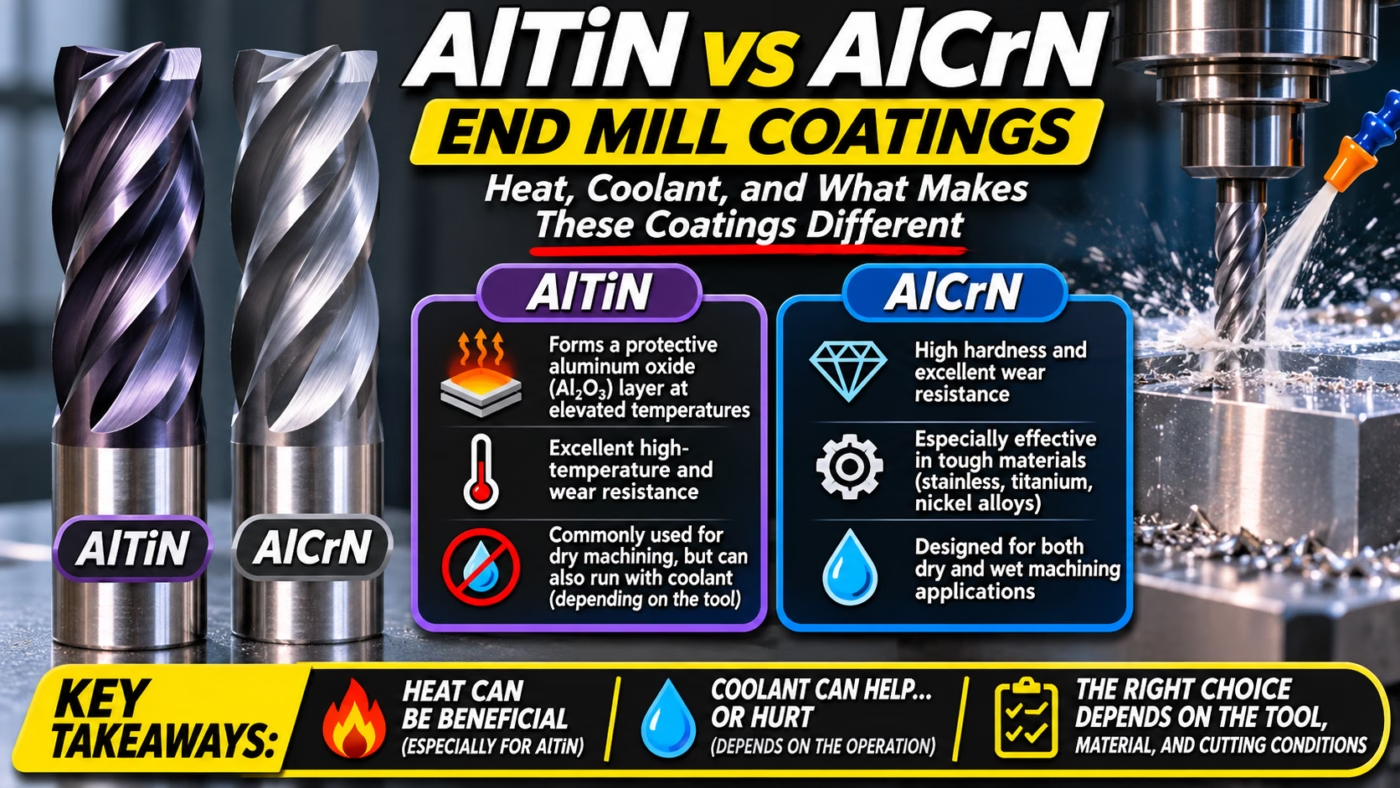
AlTiN vs AlCrN End Mills: Heat, Coolant, and What Makes These Coatings Different
One of the most misunderstood aspects of carbide end mill coatings is how they interact with heat.
Most people assume that heat is always bad for a cutting tool and that adding coolant will automatically extend tool life.
That is not necessarily true.
Some modern carbide coatings are specifically designed to perform at elevated temperatures. In the case of AlTiN, heat can actually promote the formation of a protective aluminum oxide layer on the cutting tool.
AlCrN is another high-performance coating that offers excellent temperature and wear resistance, but its chemistry is different.
Understanding AlTiN vs AlCrN requires looking beyond coating hardness and considering oxidation, thermal cycling, lubrication, cutting speed, and the material being machined.
For this article, we will rely on technical information published by established cutting-tool manufacturers rather than generic coating charts and internet machining advice.
What Is the Difference Between AlTiN and AlCrN?
Both coatings contain aluminum and nitrogen, but they use different metallic elements.
AlTiN — Aluminum Titanium Nitride
- Aluminum
- Titanium
- Nitrogen
AlCrN — Aluminum Chromium Nitride
- Aluminum
- Chromium
- Nitrogen
Both are commonly applied using Physical Vapor Deposition, or PVD, to create a thin, wear-resistant coating on the cutting tool.
Replacing titanium with chromium changes the coating’s properties, but the chemical designation alone does not tell you everything about its performance.
The aluminum content, coating thickness, layer structure, deposition process, and carbide substrate also matter.
Two manufacturers selling AlCrN-coated end mills may actually be offering considerably different cutting tools.
What Makes AlTiN Particularly Interesting?
AlTiN does more than provide a hard, wear-resistant surface.
One of its most interesting properties is what happens when it is exposed to elevated temperatures.
According to Harvey Tool’s technical guide to cutting-tool coatings, aluminum within the coating forms aluminum oxide at high temperatures.
Aluminum oxide, chemically represented as Al₂O₃, acts as a thermal barrier that helps protect the cutting tool and encourages heat transfer into the chips.
This is an important distinction.
The coating is not simply resisting heat. Its surface chemistry changes in response to elevated temperature.
That makes AlTiN particularly interesting for high-speed and dry machining applications.
How the Protective Aluminum Oxide Layer Forms
When an AlTiN-coated end mill operates at sufficiently elevated temperatures in the presence of oxygen, aluminum within the coating can react with oxygen to form aluminum oxide.
The simplified chemical reaction is:
4Al + 3O₂ → 2Al₂O₃
This represents the aluminum oxidation reaction, not the complete chemistry occurring within the multicomponent nitride coating.
The resulting surface oxide can help protect the underlying tool.
Think of the process as three distinct stages:
- The cutting edge generates heat while removing material.
- Aluminum within the coating undergoes surface oxidation.
- The resulting oxide layer provides additional thermal protection.
This is not the same thing as aluminum from the workpiece welding itself onto the cutting edge.
It is also not an unlimited buildup of material that continually makes the coating thicker. Oxide formation and removal occur as the cutting surface experiences heat, friction, and wear.
Does AlTiN Need Heat to Work?
This is where the explanation frequently gets oversimplified.
AlTiN already provides hardness and wear resistance before the cutting tool reaches elevated temperatures.
However, its ability to develop a protective oxide layer provides an additional advantage under suitable thermal conditions.
That does not mean you should deliberately overheat the end mill.
There is a difference between operating within a coating’s intended temperature range and exceeding the temperature that the complete cutting tool can tolerate.
Excessive temperature can still cause accelerated wear, coating degradation, carbide damage, and cutting-edge failure.
The goal is controlled heat management, not maximum heat generation.
Why Machinists Want Heat to Leave With the Chip
When machining steel, heat is generated through material deformation and friction around the cutting zone.
That heat is distributed between:
- The chip
- The cutting tool
- The workpiece
From a machining standpoint, allowing more heat to leave with the chip can reduce unwanted heating of the cutting tool and finished component.
This is one reason chip formation and chip evacuation are so important.
A cutter that is rubbing instead of forming a healthy chip can generate substantial heat without removing material efficiently.
A high-temperature coating cannot compensate indefinitely for poor cutting parameters.
What Makes AlCrN Different?
AlCrN, or Aluminum Chromium Nitride, is another coating family developed for demanding machining applications.
M.A. Ford’s coating specifications identify its ALtima Blaze coating as an AlCrN formulation intended for high material-removal rates and difficult-to-machine alloys.
The manufacturer specifically identifies applications involving nickel alloys and titanium, along with suitability for dry machining.
This is worth pointing out because AlCrN is sometimes described as the coolant-friendly alternative to AlTiN.
That description leaves out a substantial part of what AlCrN can do.
AlCrN is also a high-temperature coating capable of performing in dry machining applications when the tool is designed for those conditions.
AlTiN vs AlCrN: Comparing Actual Manufacturer Data
Rather than pulling numbers from unrelated coating charts, we can compare two commercial coatings from the same cutting-tool manufacturer.
M.A. Ford publishes the following specifications for its ALtima and ALtima Blaze coatings.
| Property | ALtima (AlTiN) | ALtima Blaze (AlCrN) |
|---|---|---|
| Microhardness | 3,100 HV | 3,200 HV |
| Maximum service temperature | 1,100°C | 1,100°C |
| Maximum service temperature | 2,012°F | 2,012°F |
| Coefficient of friction | 0.42 | 0.35 |
| Dry machining capability | Yes | Yes |
Source: M.A. Ford — Cutting Tool Coating Properties
There are several interesting things about this comparison.
The AlCrN formulation has a slightly higher published hardness and a lower coefficient of friction.
However, both coatings have the same published maximum service temperature.
That contradicts the common assumption that AlCrN must always have a substantially higher temperature rating than AlTiN.
These numbers apply specifically to the manufacturer’s named coatings. They should not be treated as universal specifications for every AlTiN or AlCrN end mill.
Also, a published coating coefficient of friction is not necessarily the actual coefficient of friction between the tool and chip during machining.
Not All AlTiN Coatings Have the Same Temperature Rating
This is where coating selection becomes particularly interesting.
M.A. Ford also offers an AlTiN formulation called ALtima 52, designed specifically for milling hardened steels of 52 HRC and above.
Its published specifications include:
- Microhardness: 3,600 HV
- Maximum service temperature: 1,200°C (2,192°F)
- Dry machining capability
That particular AlTiN formulation has a higher published service-temperature rating than the AlCrN formulation in the previous comparison.
Harvey Tool provides another example.
Its standard AlTiN coating has a published maximum working temperature of 1,400°F, while its silicon-enhanced AlTiN Nano coating is rated at 2,100°F.
These differences illustrate why choosing a coating based on its chemical abbreviation alone can be misleading.
Coating architecture and formulation can be just as important as the elements used in the coating.
Manufacturer temperature ratings also should not be interpreted as recommended cutting-edge operating temperatures or directly interchangeable laboratory measurements.
Can Coolant Actually Reduce Carbide End Mill Life?
Yes, under certain machining conditions.
But the reason is more complicated than simply cooling a tool that is designed to run hot.
One of the primary concerns is thermal shock.
Unlike many turning operations, milling is inherently interrupted. Every flute repeatedly enters and exits the workpiece.
During engagement, the cutting edge heats up.
After leaving the material, the cutting edge begins to cool.
This happens repeatedly throughout the machining operation.
Introducing coolant can increase the severity of those temperature fluctuations, particularly during high-temperature roughing operations.
Sandvik Coromant’s guide to dry milling and cutting fluid explains how these repeated thermal stresses can cause cracking and premature cutting-edge failure.
How Thermal Cracking Develops
Consider what happens to a carbide cutting edge during an interrupted machining operation.
- The edge enters the workpiece and experiences a rapid temperature increase.
- The edge exits the workpiece.
- Coolant rapidly removes heat from the exposed cutting surface.
- The edge enters the workpiece again.
Repeating this cycle thousands of times can create significant thermal stress.
Different regions of the cutting tool expand and contract at different rates as their temperatures change.
Over time, small cracks can develop.
Those cracks can contribute to cutting-edge chipping and premature failure.
The tool may appear to have failed from excessive cutting force when thermal cycling was actually a major contributing factor.
This is one reason dry milling can sometimes improve carbide tool life even though the average cutting temperature is higher.
Does Coolant Prevent Aluminum Oxide From Forming on AlTiN?
This is a reasonable question.
If aluminum oxide formation depends on elevated temperatures, reducing the temperature at the coating surface could influence how readily that oxide develops.
However, there is an important distinction between a plausible mechanism and a proven machining recommendation.
The manufacturer literature supports high-temperature oxide formation on AlTiN, but it does not establish that coolant universally prevents the protective layer from forming or washes it away.
Cutting-edge temperatures can also be substantially different from the temperature of the surrounding coolant and workpiece.
Without controlled testing of the specific coating, cutting operation, and coolant delivery system, it would be inappropriate to claim that flood coolant automatically eliminates the benefits of AlTiN.
Is AlTiN Intended Only for Dry Machining?
No.
This is one of the biggest misconceptions surrounding the coating.
Kennametal’s HARVI II solid-carbide end mill provides a direct example.
Its KC643M grade uses a multilayer AlTiN coating, and Kennametal specifically identifies wet machining applications involving stainless steel and titanium.
That means a major cutting-tool manufacturer recommends coolant with a particular AlTiN-coated end mill.
The correct conclusion is not that AlTiN should never be used with coolant.
The correct conclusion is that coolant compatibility depends on the specific tool and cutting application.
Is AlCrN Better With Coolant?
Certain AlCrN-containing tool grades are designed to perform extremely well under wet machining conditions.
However, AlCrN is not automatically immune to thermal shock.
Kennametal’s KCPM40 milling grade provides an especially interesting example.
The manufacturer uses an advanced PVD coating incorporating both TiAlN and AlCrN, with thermal-shock resistance being an important feature of the grade.
Kennametal identifies this grade as suitable for both wet and dry machining.
See Kennametal’s KCPM40 grade information.
This is an insert grade rather than a solid-carbide end mill, but it demonstrates how manufacturers can combine coating chemistries to achieve specific performance characteristics.
AlCrN is also used on internally cooled cutting tools.
For example, Walter’s DB133 solid-carbide micro drill combines an AlCrN tip coating with internal coolant delivery.
Drilling and milling have different thermal conditions, so this does not establish the correct coolant strategy for an end mill. It does, however, demonstrate that AlCrN coatings can be incorporated into tools specifically designed for coolant use.
Does AlCrN Develop a Protective Oxide Layer Too?
Because AlCrN also contains aluminum, it is reasonable to investigate whether its high-temperature oxidation behavior provides similar protective mechanisms.
However, chromium changes the chemistry of the coating, and its oxidation behavior should not automatically be assumed to be identical to AlTiN.
The cutting-tool manufacturer literature referenced in this article establishes excellent temperature and oxidation resistance for specific AlCrN formulations.
It does not provide enough detail to establish a universal oxide-layer composition, formation temperature, or growth rate for all AlCrN end mills.
Those are different claims that require more detailed evidence.
This is exactly why I prefer manufacturer-specific technical information over generalized coating descriptions.
Why Intermittent Coolant Can Be Particularly Problematic
Imagine roughing a deep steel pocket with flood coolant.
The coolant reaches the cutter consistently during one portion of the toolpath.
As the cutter moves deeper into the pocket, the workpiece and chips obstruct the coolant stream.
The cutting tool heats up.
When it moves into an exposed area, coolant suddenly reaches the cutting edge again.
Now the tool is experiencing additional temperature changes beyond the normal interrupted nature of milling.
Sandvik Coromant recommends plentiful cutting-fluid delivery when wet milling is necessary.
A consistent coolant supply is fundamentally different from occasionally splashing coolant onto a heavily heated cutting tool.
When Dry Machining May Be the Better Choice
Dry machining is worth investigating when performing suitable carbide roughing operations in steel or hardened steel.
Potential advantages include:
- Reduced thermal shock
- Fewer severe temperature fluctuations
- Effective use of high-temperature coating properties
- Elimination of inconsistent coolant delivery
However, dry machining still requires effective chip evacuation.
Leaving hot chips trapped in a pocket can create another set of problems.
Compressed air may help clear chips when the cutting operation and machine enclosure permit it.
The manufacturer’s recommendations should determine whether dry machining is appropriate for the specific tool.
When Coolant May Be the Better Choice
Coolant does considerably more than reduce cutting temperature.
It can provide lubrication, evacuate chips, reduce workpiece temperature, and help maintain dimensional stability.
Sandvik Coromant identifies several situations where cutting fluid can be beneficial, including:
- Finishing stainless steel
- Milling heat-resistant alloys at relatively low cutting speeds
- Machining thin-walled components susceptible to distortion
- Applications requiring improved chip evacuation
In these situations, the benefits of coolant may outweigh the disadvantages associated with thermal cycling.
A coating that performs exceptionally well during dry steel roughing may not be the best choice for finishing a thin-walled stainless steel component.
The operation matters.
AlTiN vs AlCrN for Mild Steel
Both coating families are available on cutters designed for steel machining.
For general-purpose milling of materials such as 1018 and A36, I would not automatically pay more for an AlCrN-coated cutter simply because it is marketed as a newer coating.
I would compare:
- Recommended cutting speed
- Recommended chip load
- Permitted radial and axial engagement
- Tool geometry
- Coolant recommendations
- Tool cost
A well-designed AlTiN end mill may provide excellent results.
An AlCrN cutter may offer advantages in certain applications, but those advantages need to translate into actual productivity or tool-life improvements.
AlTiN vs AlCrN for 4140 Alloy Steel
4140 pre-hardened steel is a particularly interesting application because it combines substantial cutting forces with elevated cutting temperatures.
Both coating families deserve consideration.
The correct choice depends on the actual material hardness and the intended operation.
Heavy roughing places different demands on the cutting edge than a light finishing pass.
Long-reach machining also introduces mechanical limitations that may prevent you from taking advantage of a coating’s full performance capability.
If the cutter is deflecting excessively or experiencing chatter, changing coatings may not solve the underlying problem.
AlTiN vs AlCrN for Stainless Steel
Stainless steel can introduce adhesion, work hardening, chip-evacuation problems, and substantial heat around the cutting edge.
Coating selection is important, but the cutting geometry and actual machining parameters are equally important.
Gühring’s RF 100 Sharp end mill is an example of an AlCrN-coated carbide tool developed for demanding materials, including stainless steel.
Kennametal’s previously mentioned AlTiN-coated HARVI II is another example of a cutter specifically suitable for stainless steel.
Both coating families have legitimate applications here.
The specific tool design matters more than declaring a universal winner.
AlTiN vs AlCrN for Hardened Steel
High-temperature performance becomes particularly important when machining hardened steels.
Some coatings are specifically formulated for hard milling rather than general-purpose machining.
M.A. Ford’s ALtima 52 is a good example of an AlTiN coating developed for this purpose.
The fact that an AlCrN coating performs well in stainless steel or titanium does not automatically mean it will outperform a dedicated hard-milling AlTiN formulation.
Look for a cutter with published cutting data covering the actual hardness of the material you intend to machine.
Why Coating Hardness Alone Is Not Enough
It is tempting to compare two coatings and simply select the one with the higher Vickers hardness rating.
However, coating hardness is only one performance characteristic.
A cutting tool also needs appropriate:
- Edge toughness
- Coating adhesion
- Oxidation resistance
- Abrasion resistance
- Thermal stability
- Resistance to material adhesion
A very hard coating that performs exceptionally well under one set of cutting conditions may experience premature damage under another.
For interrupted cutting operations, resistance to cracking and chipping can matter more than a small increase in coating hardness.
The Carbide Underneath the Coating Still Matters
The coating is only the outermost portion of the cutting tool.
Underneath it is the cemented carbide substrate that provides the structural foundation for the cutting edge.
Different carbide grades can have different grain sizes, binder contents, hardness, and toughness.
The cutting edge itself can also be prepared differently before coating.
That means comparing two end mills with different coatings is rarely a pure comparison of coating chemistry.
You may also be comparing different carbide grades, flute geometries, edge preparations, and manufacturing techniques.
This is something that should be considered whenever you see an end mill comparison online.
You Cannot Reliably Identify a Coating by Color
Many AlTiN-coated end mills have a dark charcoal or nearly black appearance.
AlCrN coatings can also appear dark gray or metallic gray.
Lighting, coating thickness, surface preparation, and the deposition process can all influence appearance.
Do not assume that a particular coating can be positively identified by looking at the color of the cutter.
The manufacturer’s product designation and technical specifications are much more reliable.
How I Would Conduct an AlTiN vs AlCrN Tool-Life Test
To make a meaningful comparison, I would want to control as many variables as possible.
Ideally, both cutters would have the same carbide substrate, diameter, flute count, geometry, edge preparation, and stickout.
The test would also control:
- Workpiece material and hardness
- Spindle speed
- Feed per tooth
- Radial engagement
- Axial engagement
- Toolholder and runout
- Toolpath strategy
- Coolant type and delivery
I would then test four combinations.
| Test | Coating | Cutting condition |
|---|---|---|
| 1 | AlTiN | Dry |
| 2 | AlTiN | Flood coolant |
| 3 | AlCrN | Dry |
| 4 | AlCrN | Flood coolant |
This would only be appropriate if both specific cutters were approved by their manufacturers for the proposed conditions.
I would measure tool wear at consistent intervals rather than relying on how long each cutter survives before breaking.
Important results would include:
- Total volume of material removed
- Cutting length
- Flank wear
- Edge chipping
- Surface finish
- Dimensional consistency
- Spindle load
- Tool cost per finished part
I would also repeat each test to reduce the influence of random tool failures.
Only then could I begin drawing meaningful conclusions about which coating performs better under those particular cutting conditions.
Tool Cost Should Be Evaluated Against Material Removed
Suppose an AlTiN-coated end mill costs $40 and an AlCrN-coated end mill costs $60.
The AlCrN cutter costs 50% more.
If both cutters produce the same number of acceptable parts at the same cutting parameters, the more expensive cutter offers no tooling-cost advantage.
However, suppose the results are different.
| AlTiN | AlCrN | |
|---|---|---|
| End mill cost | $40 | $60 |
| Acceptable parts produced | 20 | 40 |
| Tooling cost per part | $2.00 | $1.50 |
In this hypothetical example, the more expensive end mill actually reduces tooling cost per part by 25%.
These are illustrative numbers, not actual coating test results.
The same reasoning applies to material-removal rates.
A cutter that allows faster machining may reduce manufacturing cost even if its total operating life in minutes is shorter.
The goal is not necessarily the longest-lasting cutter.
It is the lowest cost of producing an acceptable finished part.
Why This Matters to the Products We Manufacture
Cutting-tool selection has a direct impact on the cost, accuracy, and consistency of the products we manufacture at Beck Tools.
The aluminum components used in our Belt Grinder Wheel Kit require an entirely different machining approach from many of the steel components used throughout the BA Shredder 2×72 Belt Grinder.
There is no reason to expect one coating or cutting-tool geometry to perform equally well across every application.
The most effective manufacturing process comes from selecting the tool around the material, geometry, and cutting conditions.
Manufacturer Technical Resources
The technical information in this article is based on cutting-tool manufacturer literature. These are useful resources for further research.
- Harvey Tool — Overview of Tool Coatings and Maximizing Tool Performance
- M.A. Ford — Cutting Tool Coating Properties and Specifications
- Sandvik Coromant — Dry Milling or With Cutting Fluid
- Kennametal — HARVI II AlTiN-Coated Solid Carbide End Mill
- Kennametal — KCPM40 TiAlN/AlCrN Milling Grade
- Gühring — RF 100 Sharp AlCrN End Mill
- Walter — DB133 AlCrN-Coated Micro Drill With Internal Coolant
The Bottom Line
AlTiN and AlCrN are both extremely capable cutting-tool coating families.
AlTiN is particularly interesting because elevated cutting temperatures can promote the formation of a protective aluminum oxide layer.
AlCrN offers excellent high-temperature performance and wear resistance, with specific formulations developed for demanding machining applications.
However, the common explanation that AlTiN is for dry machining and AlCrN is for wet machining is far too simplistic.
Both coating families can be used in suitable dry applications.
Both can also be incorporated into tooling designed for wet applications.
Coolant can reduce tool life when it creates severe thermal cycling, but it can also improve tool life, lubrication, chip evacuation, and dimensional stability under the right conditions.
The correct choice depends on the complete cutting tool and machining process, not simply the coating abbreviation.
Start with the cutting-tool manufacturer’s recommendations, understand why those recommendations exist, and evaluate performance using controlled machining tests.
If you need a custom component, prototype, replacement part, or short production run manufactured, visit our CNC Machining Services page to request a quote.
